

Every business that ships products faces the same question at some point: why do some packages arrive in perfect shape while others show up crushed, torn, or contaminated? Most of the time, the answer traces back to one decision made well before the product ever left the warehouse. It comes down to which box and packaging suppliers you chose to work with.
Packaging does more than hold a product in place. It protects against physical damage, moisture, temperature changes, and contamination during transit. It also communicates something about your brand. A product that arrives intact and well-packaged signals reliability. One that arrives damaged signals something else entirely.
This guide breaks down what to look for when selecting packaging suppliers, the types of materials worth knowing about, and the questions you should ask before signing any supply agreement.
Why Your Choice of Packaging Suppliers Directly Affects Product Safety
Packaging failure is not just a cosmetic problem. According to data from the ISTA (International Safe Transit Association), transit damage accounts for billions in product losses globally every year. The packaging supply chain is a critical point of control that many businesses underinvest in.
When you work with the wrong supplier, you may end up with materials that are not calibrated for your product weight, shipping conditions, or handling environment. A corrugated box rated for light loads will not protect a heavy industrial part. A flexible film without proper moisture resistance will not keep food fresh on a long transit route.
Choosing the right packaging supplier means finding a manufacturer who understands your specific application, uses materials tested to relevant standards, and can deliver consistently at scale.
Types of Packaging Materials Used in Product Delivery
Here is a quick breakdown of the main packaging material categories and what each is best suited for:
Corrugated Boxes and Cartons
Corrugated packaging is the most widely used shipping container for consumer goods, industrial parts, and e-commerce orders. It offers a good balance of strength, weight, and cost. The key variables are flute type (the thickness of the inner corrugation layer) and the bursting strength of the liner boards. Suppliers should be able to provide ECT (Edge Crush Test) and BCT (Box Compression Test) ratings on request.
Flexible Packaging Films and Laminates
Flexible packaging covers a broad range: pouches, wraps, multilayer laminates, and shrink films. These are common in food, pharmaceutical, and industrial applications where rigid boxes are either impractical or too heavy. Multilayer films can be engineered to provide specific barrier properties against oxygen, moisture, UV light, and chemical exposure.
Surface Protection Films
Surface protection films are applied directly to finished surfaces, panels, and industrial components to prevent scratches, abrasion, and contamination during storage, handling, and transport. These are particularly common in the construction, metal fabrication, and aluminum panel industries. Adhesion strength and film thickness need to match the surface type and duration of protection required.
Modified Atmosphere Packaging (MAP) Films
For perishable food products, modified atmosphere packaging films control the gas composition inside the pack to slow spoilage. MAP films require precise gas transmission rate specifications and are subject to food contact material regulations. When sourcing MAP films, always verify compliance with FSSAI (in India) or equivalent standards in your target market.
Key Criteria for Evaluating Box and Packaging Suppliers
Let’s break it down. When you are assessing potential packaging suppliers, these are the areas that matter most:
- Material testing and certifications: Ask for test reports on compression strength, barrier performance, or adhesion depending on the material type. Reputable manufacturers test to recognized standards such as ASTM, ISTA, or BIS.
- Manufacturing experience: A supplier with years of production history in your specific material category will have worked through common failure modes already. Look for demonstrated experience in your product category.
- Application-specific knowledge: Generic packaging will rarely perform as well as packaging designed for your specific use case. Suppliers who ask detailed questions about your product, transit conditions, and storage environment are more likely to recommend the right solution.
- Production capacity and delivery reliability: Packaging supply disruptions can halt your entire shipping operation. Confirm that your supplier can handle your volume requirements, especially during peak seasons, and has a track record of on-time delivery.
- Customization options: Not every product ships well in a standard-sized box or off-the-shelf film. Suppliers who offer custom sizing, material layering, and print options give you more control over the end result.
- Sustainability practices: Many buyers now require packaging to meet sustainability targets. Ask whether the supplier offers recyclable materials or recycled content or has a material recovery or recycling program in place.
Questions to Ask Packaging Suppliers Before You Commit
Before finalizing any supplier agreement, run through these questions:
- What testing do you perform on finished packaging materials, and can you share recent test reports?
- What is your minimum order quantity, and how do lead times change at higher volumes?
- What quality control checks happen during production, not just at the end?
- Can you provide samples before we place a bulk order?
- What is your process when a batch does not meet spec? How are replacements or credits handled?
- Do your materials comply with relevant food contact, safety, or environmental regulations for my target market?
Red Flags to Watch for When Sourcing Packaging Materials
Not every supplier who quotes competitively is actually capable of delivering consistent quality. Here are warning signs worth paying attention to:
- Reluctance to share material test data or certifications
- No option for pre-production samples
- Vague answers about raw material sourcing
- No dedicated quality control team or process documentation
- Unusually low pricing with no explanation of how costs are managed
What to Look for in Flexible Packaging and Surface Protection Film Suppliers
If your products include food, electronics, construction materials, or anything with a finished surface that can scratch easily, flexible and protective film packaging deserves special attention.
For flexible laminates used in food packaging, the film structure matters. A multilayer film designed for extended shelf life needs to have the right combination of oxygen transmission rate (OTR) and moisture vapor transmission rate (MVTR) for your specific product. These are not one-size-fits-all numbers. A film that works for a dry snack may be completely wrong for fresh produce.
For surface protection films used in industries like aluminum composite panels (ACP) or metal fabrication, the adhesive type and thickness of the film need to be matched to the substrate. Applying the wrong film can leave adhesive residue, cause surface discoloration, or fail to protect at all.
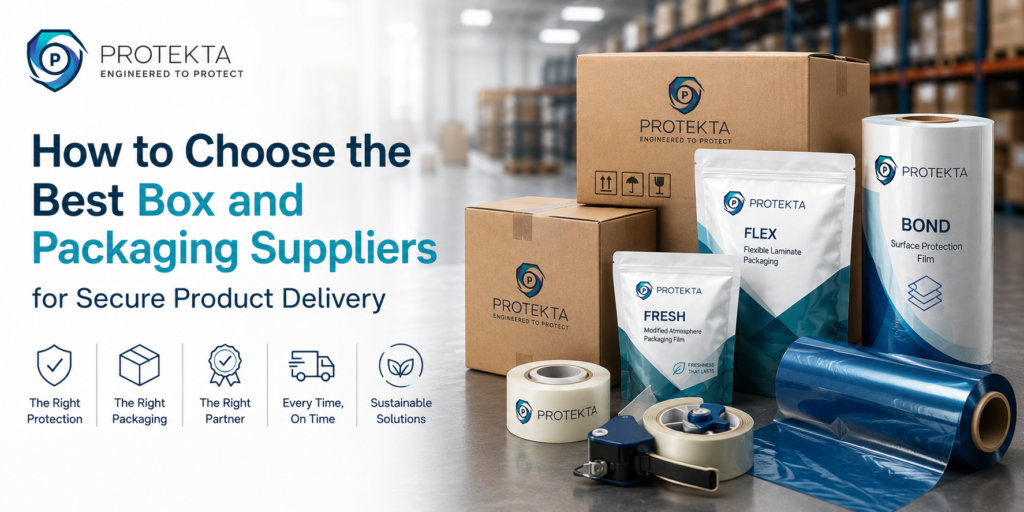
Protekta, a brand launched by Girdhar Roll Wrap with over 40 years of manufacturing experience, produces a range of flexible packaging and surface protection films specifically designed for these applications. Their product range includes flexible laminates for food and industrial use (PROTEKTA FLEX), modified atmosphere packaging films for fresh produce (PROTEKTA FRESH), and surface protection films for aluminum composite panels (PROTEKTA BOND), all manufactured from their facility in Bhiwadi, Rajasthan.
How to Evaluate a Packaging Supplier’s Track Record
Numbers matter, but so does context. Here are a few ways to get a realistic picture of how a supplier actually performs:
- Ask for client references in your industry: A supplier with existing customers in your sector has already solved problems similar to yours. Speaking with those customers directly is more informative than any brochure.
- Request a facility visit or virtual tour: Seeing the production floor tells you a lot. Is the facility clean and organized? Are quality checks happening inline or only at the end of a run?
- Start with a trial order: Before committing to a large volume contract, place a smaller order and put the packaging through your actual handling and transit conditions. This is the most reliable test.
- Check complaint resolution history: Every supplier has had a batch fail at some point. What matters is how they handled it. Ask directly.
Domestic vs. International Packaging Suppliers: What to Consider
Many businesses weigh the cost advantage of sourcing packaging internationally against the risks of longer lead times, quality variability, and logistics complexity. Here is a practical way to think about it:
Domestic packaging suppliers generally offer faster replenishment cycles, easier communication, and more straightforward quality dispute resolution. They also often have a better understanding of local regulatory requirements. For businesses that ship frequently or whose packaging needs change often, domestic suppliers are usually the more dependable option.
International sourcing can make sense for standardized, high-volume commodities where specification rarely changes and lead time is predictable. But for specialized materials like multilayer films, surface protection films, or custom laminates, working with a supplier who can communicate in real time and visit your facility if needed is usually worth the extra cost.
A Practical Checklist for Selecting Box and Packaging Suppliers
Use this checklist when shortlisting suppliers:
- Define your packaging requirements clearly before approaching suppliers (material type, dimensions, barrier specs, certifications needed)
- Shortlist at least three suppliers with experience in your application area
- Request material test reports and certifications from each
- Ask for samples and test them under real shipping conditions
- Verify production capacity, lead times, and delivery track record
- Confirm compliance with all applicable food contact, safety, or environmental regulations
- Negotiate a trial period before signing a long-term supply agreement
Working with Specialized Packaging Manufacturers for Better Results
There is a real difference between a distributor who resells packaging and a manufacturer who actually makes it. When you buy directly from a manufacturer, you get clearer visibility into material specifications, faster problem resolution, and often better pricing because there is no middleman in the chain.
Manufacturers who have been producing specialized packaging for decades tend to have solved problems that newer entrants are still figuring out. They also have the equipment and the process knowledge to customize materials for specific applications rather than just selling what happens to be in stock.
If you are sourcing flexible packaging films, multilayer laminates, or protective films for industrial surfaces, working with a dedicated manufacturer like Protekta, which operates from a fully equipped plant and has served industrial and food sector clients for years, gives you access to both application-specific product design and consistent supply. You can explore their product range and contact their team at Protekta website.
Final Thoughts
Finding the right packaging supplier is not a one-time task. Your needs will change as your product line grows, your shipping volumes increase, and regulations evolve. The best supplier relationships are built on ongoing communication, shared quality data, and the flexibility to adapt materials as conditions change.
Take the time to evaluate suppliers properly before you commit. Ask the hard questions, test the materials under real conditions, and do not let low pricing be your only filter. The cost of packaging failure is almost always higher than the cost of getting it right from the start.
Frequently Asked Questions
1. What should I look for when comparing box and packaging suppliers?
Start with material quality and testing data, then look at production capacity, delivery reliability, and application experience. Price matters, but a supplier who cuts costs on raw materials will cost you more in damaged products and returns over time.
2. How do I know if a packaging supplier is reliable for long-term supply?
Ask for client references, check their delivery track record, and start with a trial order before committing to volume contracts. A supplier who performs consistently on smaller orders will usually perform consistently at scale, and vice versa.
3. What is the difference between flexible packaging and rigid packaging for shipping?
Rigid packaging, like corrugated boxes, provides structural protection and is best for heavy or fragile items. Flexible packaging, like films and pouches, is lighter and better for products that need barrier protection against moisture or oxygen. Many applications use both together.
4. Do I need food-grade certification from my packaging supplier if I sell food products?
Yes. Food contact materials must comply with applicable food safety regulations. In India, this falls under FSSAI guidelines. In the EU, it is Regulation (EC) No 1935/2004. Always request written confirmation of compliance and the relevant test documentation from your supplier.
5. Is it better to buy packaging directly from a manufacturer or through a distributor?
Buying direct from a manufacturer generally gives you better pricing, clearer specification control, and faster problem resolution. Distributors can be useful when you need small quantities from multiple product types, but for specialized materials used consistently, going direct is usually the smarter choice.