
Walk into any supermarket, pharmacy, or hardware store today and you will notice something different about the shelves. Glass jars are giving way to pouches. Rigid plastic tubs are being replaced by resealable bags. Tin cans are disappearing behind laminated film sachets. This is not a trend driven by aesthetics. It is a structural shift in how industries think about protecting, transporting, and delivering products.
The global flexible packaging market was valued at approximately USD 239 billion in 2025 and is projected to reach around USD 424 billion by 2034, growing at a compound annual growth rate of nearly 6% according to research by Precedence Research. That is not a niche category gaining a foothold. That is one of the fastest-growing segments in the entire global packaging industry, and it is pulling market share directly away from rigid containers.
So what is driving this? Here is a breakdown of the real reasons.
What Makes Flexible Packaging Different from Rigid Packaging
Before getting into the why, it helps to understand the what.
Rigid packaging refers to containers that hold their shape regardless of contents. Think glass bottles, metal cans, hard plastic tubs, cardboard boxes. They are structurally fixed.
Flexible packaging refers to formats that can conform, compress, or take the shape of their contents. This includes films, pouches, sachets, wraps, rollstock, laminates, and bags. Materials typically include polyethylene, polypropylene, aluminum foil, paper, or multi-layer laminated combinations of these.
The key distinction is not just physical form. It is the performance difference across the entire product lifecycle from manufacturing and filling to transport, shelf life, and end disposal.
The Core Benefits of Flexible Packaging Over Rigid Alternatives
- 1. Dramatically Lower Weight and Material Use
This is where flexible packaging wins most decisively in the flexible vs rigid packaging debate.
According to the Flexible Packaging Association (FPA), packaging just 100 pounds of beverage in flexible format requires about 2.5 pounds of material. Packaging the same volume in glass requires approximately 84 pounds of material. That is a staggering difference and it compounds across every step of the supply chain.
Less material means less energy to manufacture, less fuel to transport, and less waste at end of life. The FPA’s life cycle assessments consistently show that flexible packaging outperforms rigid alternatives on carbon impact, fossil fuel usage, and water consumption across nearly every product category tested.
A particularly striking data point: a rigid PET container for laundry detergent pods generates over 726% more greenhouse gas emissions than an equivalent flexible pouch with zipper, according to research published by Perfect Packaging and cited by the FPA.
- Significant Transport and Logistics Savings
One truckload of flat pouches can carry the equivalent of 15 to 25 truckloads of empty rigid containers, according to the Flexographic Technical Association. This is because flexible materials ship flat or on a roll, taking up a fraction of the space.
For businesses managing distribution at any scale, this matters. Fewer truck runs means lower fuel bills, lower freight costs, and a smaller carbon footprint per unit shipped. In the e-commerce era, where dimensional weight pricing penalizes bulky shipments, flexible formats are a practical financial advantage.
North American online sales expanded by 15.4% in 2024, and retailers are actively moving toward flexible bubble mailers and film-based packaging to cut dimensional-weight fees — some by as much as 30%, according to Mordor Intelligence’s 2026 flexible packaging industry report.
- Extended Shelf Life Through Barrier Technology
Modern flexible packaging is not just a bag. It is an engineered multi-layer structure designed to control the environment around a product.
Laminated films can combine layers of different materials polyethylene for moisture resistance, aluminum foil for oxygen and light blocking, BOPP for heat resistance into a single film that keeps products fresher for longer. Modified atmosphere packaging (MAP) films, for instance, allow manufacturers to control the gas mixture inside a package to slow spoilage.
According to the FPA, this shelf life extension does meaningful environmental work. Placing grapes in perforated polyethylene bags, for example, resulted in a 20% reduction of in-store waste compared to selling them loose. Extending shelf life is one of the most effective ways to reduce food waste and food production accounts for over a quarter of all global greenhouse gas emissions, according to data cited by the FPA.
This is one reason why producers of fresh produce, dairy, meat, and even pharmaceuticals are increasingly choosing flexible laminate solutions over rigid alternatives.
- Consumer Convenience That Rigid Containers Cannot Match
Squeeze pouches. Resealable zippers. Spout caps. Easy-tear notches. Stand-up bases.
These are not gimmicks. They are functional features that rigid containers simply cannot offer in the same form factor. A glass jar of ketchup requires a knife to scrape out the last serving. A flexible inverted squeeze pouch delivers it cleanly until the last drop.
Resealable pouches also solve a real consumer problem: portion control and freshness after opening. For dry foods, snacks, pet food, and powdered supplements, the ability to reseal and flatten a flexible pouch is genuinely more practical than a rigid canister with a lid.
The rise of stand-up pouches is a direct response to this demand. Stand-up pouches now account for around 31.8% of the flexible packaging market by product type, according to Coherent Market Insights. Their self-standing ability removes the need for secondary packaging like boxes, further cutting material use and cost.
- Cost Advantages in Manufacturing and Production
Flexible packaging requires less raw material per unit than rigid alternatives. It can be produced in high-volume, automated processes using form-fill-seal technology where the packaging is formed, filled, and sealed in one continuous operation. This reduces labor costs and production time.
From a working capital perspective, rollstock and pre-formed pouches also take up far less warehouse space than equivalent rigid containers. For manufacturers dealing with tight storage, this has real operational value.
Which Industries Are Making the Switch?
Food and Beverage
This is the biggest sector driving the shift. Food and beverage packaging accounts for approximately 48.7% of the global flexible packaging market in 2025, according to Precedence Research. Soup that once came in steel cans now ships in flexible stand-up pouches. Pet food that came in rigid plastic pails increasingly comes in resealable laminated bags. Ready meals, snack foods, infant formula, coffee the list is long and growing.
Pharmaceuticals
The pharmaceutical sector is the fastest-growing application segment in flexible packaging, expanding at a projected CAGR of 6.1% through 2033 according to Grand View Research. Strip packs, blister films, sachets, and unit-dose pouches offer tamper evidence, moisture barrier performance, and compact form factors that work better than rigid pill bottles for many drug types and delivery formats.
Personal Care and Cosmetics
Shampoo sachets, detergent pods, lotion tubes, and face mask pouches have steadily replaced their rigid counterparts. Brands are discovering that mono-dose flexible sachets reduce product waste and allow consumers to trial products at low cost a significant marketing advantage.
Industrial and Agricultural Applications
Woven polypropylene bags, FIBC (flexible intermediate bulk container) bags, and coated film sacks are replacing rigid drums and pails for cement, fertilizers, resins, and chemicals. The industrial flexible packaging market alone was valued at over USD 81 billion in 2024, according to Research Nester.
The Sustainability Reality: Flexible Is Not Perfect, But It Leads
Here is where the conversation gets honest.
Flexible packaging has a real recycling challenge. Multi-layer laminated films are difficult to separate and sort, which limits their recyclability through conventional curbside systems. Only about 7% of flexible plastic packaging collected in the UK is recycled, according to WRAP data cited by Mordor Intelligence.
That is a genuine problem. But it needs to be seen in the right context.
Flexible Packaging Europe has published data showing that if all food were packed in flexible packaging instead of rigid alternatives even at a 0% recycling rate the total carbon footprint of packaging in the EU would still fall by 40%. That is because the sheer reduction in material volume and transport energy outweighs the recycling gap.
The industry is working to close that gap. Mono-material structures made entirely from polyethylene (PE) are being developed and adopted specifically because they can be recycled through existing drop-off streams. Brands like Amcor have partnered with major FMCG companies to introduce post-consumer recycled content at scale. Paper-based flexible formats from companies like Mondi are gaining ground for certain applications.
The direction of travel is clear: flexible packaging is becoming more recyclable, not less.
What Protekta Offers in Flexible Packaging
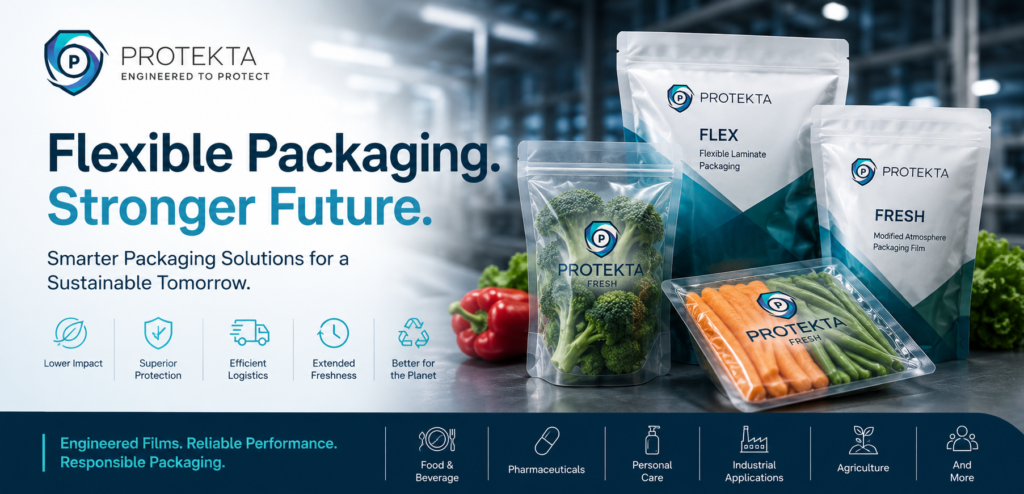
For manufacturers and businesses in India looking at modern packaging solutions, Protekta a brand backed by over 40 years of manufacturing experience from Girdhar Roll Wrap produces a range of flexible packaging and protection film products designed for real-world industrial and food packaging needs.
Their product line includes Protekta Flex (flexible laminate packaging for food and industrial use), Protekta Fresh (modified atmosphere packaging film for extended shelf life), and surface protection films for materials like aluminium composite panels. The Bhiwadi, Rajasthan-based facility serves businesses across multiple sectors and brings the manufacturing depth of a long-established industrial operation to what are genuinely modern packaging requirements.
You can explore Protekta’s full product range at their website.
Flexible vs Rigid Packaging: A Quick Comparison
| Factor | Flexible Packaging | Rigid Packaging |
| Material use | Significantly lower | Higher |
| Transport efficiency | High (ships flat/rolled) | Low (ships as formed containers) |
| Shelf life extension | Strong barrier options | Varies by material |
| Consumer convenience | Resealable, spouts, squeeze | Fixed form, often less practical |
| Carbon footprint | Generally lower across lifecycle | Higher, especially for glass and metal |
| Recyclability | Improving; some gaps remain | Generally better established |
| Cost per unit | Lower for many formats | Higher raw material and freight costs |
What to Expect Going Forward
The shift from rigid to flexible is not just a cost play. It reflects genuine changes in how supply chains operate, how consumers interact with products, and what sustainability means in practice.
The pouches segment alone is expected to grow at a CAGR of 5.9% through 2033, according to Grand View Research. Bioplastics, a largely new category within flexible packaging, are projected to grow at 6.7% annually over the same period.
Regulatory pressure is also a factor. Extended Producer Responsibility (EPR) laws are proliferating across the US, Europe, and increasingly in India, pushing brands to reduce total packaging weight, something flexible formats make much easier than rigid ones.
For procurement managers, brand owners, and operations teams, the practical question is no longer whether flexible packaging is viable. It clearly is. The question is which specific format, barrier specification, and material structure fits the product’s actual needs.
Frequently Asked Questions
Q1: What is the main difference between flexible and rigid packaging?
Flexible packaging uses materials like films, pouches, and laminates that can conform to the shape of their contents. Rigid packaging, such as glass jars, metal cans, and hard plastic bottles, holds a fixed shape. The difference affects weight, cost, transport, and shelf life performance.
Q2: Is flexible packaging more sustainable than rigid packaging?
Across most lifecycle metrics carbon emissions, fossil fuel use, water consumption, and material to landfill flexible packaging performs better than rigid alternatives. The main challenge is end-of-life recyclability, which the industry is actively addressing through mono-material designs and better collection infrastructure.
Q3: Which industries use flexible packaging the most?
Food and beverage is the largest sector, accounting for nearly half of global flexible packaging demand. Pharmaceuticals, personal care, and industrial goods are all growing users. The format works wherever weight reduction, shelf life, or consumer convenience is a priority.
Q4: What is MAP film and how does it extend shelf life?
Modified atmosphere packaging (MAP) film controls the composition of gases inside a sealed package typically reducing oxygen and increasing nitrogen or CO2. This slows microbial growth and oxidation, extending the usable life of fresh produce, meat, and dairy without the need for preservatives.
Q5: How does Protekta’s flexible packaging serve food manufacturers?
Protekta produces flexible laminate films and MAP films designed for food packaging applications. Their Protekta Fresh line is built specifically to extend shelf life through modified atmosphere technology, while Protekta Flex covers broader flexible laminate packaging needs for both food and industrial use. More details are available at protekta.