
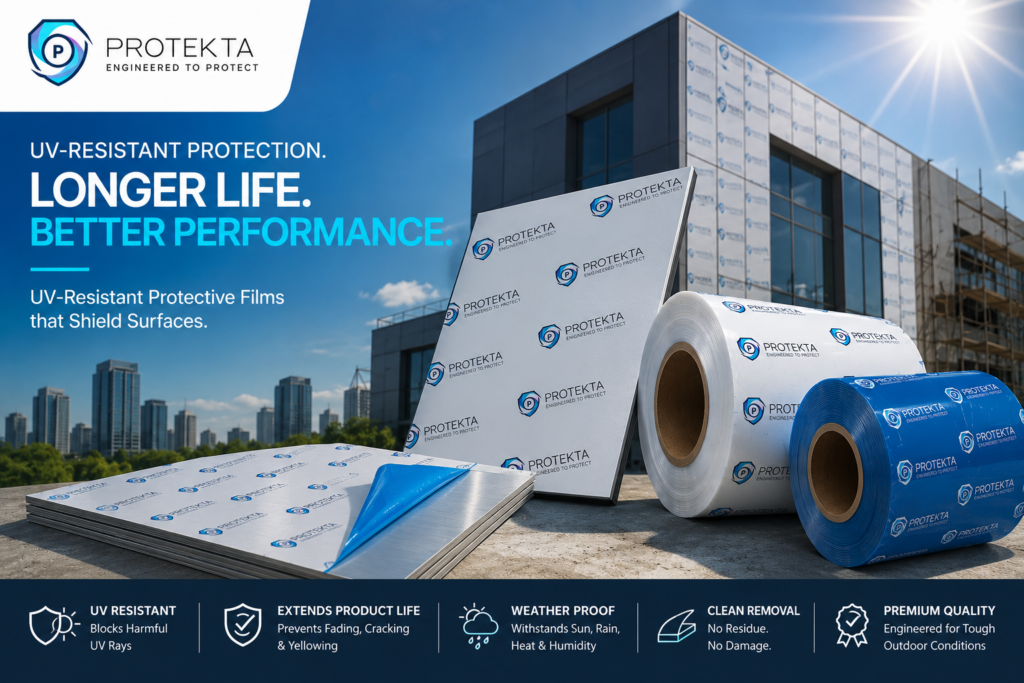
Every material exposed to sunlight is under constant attack. The surface you can see starts to fade. The structure beneath gets brittle. And eventually, what was once a quality product becomes a liability that needs replacing. UV-resistant protective film is one of the most practical ways to slow that process down and in many outdoor applications, it makes the difference between a surface that lasts years and one that fails in months.
This article explains why UV damage happens, how weather resistant film works to stop it, and which outdoor applications benefit most from surface protection.
Why UV Radiation Is So Destructive to Outdoor Surfaces
Let’s start with the science, because understanding the problem makes the solution easier to evaluate. Ultraviolet radiation from the sun falls between 290 and 400 nanometers in wavelength. It accounts for only about 4.6% of the solar spectrum, but it carries enough energy to break chemical bonds in polymer chains the molecular backbone of most plastics, paints, adhesives, and composite materials. Once those bonds break, the damage compounds fast.
Here is what the research shows: when UV photons hit a polymer surface, they are absorbed by chemical groups called chromophores. This initiates a chain reaction called photooxidation UV light reacts with oxygen in the air to form free radicals, which then attack adjacent molecular chains. The result is progressive chain scission: the polymer literally breaks apart at a molecular level. Mechanical properties deteriorate. Tensile strength drops. Surfaces crack, discolor, and chalk.
Photo-oxidation the combined action of light and oxygen is the most significant factor in the weathering of plastics. It causes polymer chains to break apart through chain scission, making the material increasingly brittle and eventually leading to mechanical failure.
The visible effects are familiar: garden chairs lose their gloss and become brittle, stadium seats turn chalky, and some plastics yellow and crack. UV radiation causes loss of impact strength, changes in color, cracking, loss of elongation and tensile strength, and surface chalking.
For industries that rely on aluminum composite panels, plywood surfaces, or coated metals in outdoor settings, this isn’t just an aesthetic problem. It’s a structural and financial one.
How UV-Resistant Protective Film Actually Works
A UV resistant protective film does not simply cover a surface. It acts as a sacrificial barrier, absorbing or deflecting UV radiation before it reaches the substrate underneath.
There are two main mechanisms at work in most weather resistant films:
UV Absorbers (UVAs): These chemical additives are built into the film material. They preferentially absorb high-energy UV photons and dissipate that energy as low-level heat, preventing it from reaching the underlying surface. Think of them as a molecular sunscreen for your materials.
Hindered Amine Light Stabilizers (HALS): HALS compounds work by scavenging the free radicals formed when light energy breaks molecular bonds. By neutralizing these reactive species, HALS interrupt the chain reaction of degradation, significantly slowing the material’s breakdown. HALS don’t block UV light they mop up the chemical damage before it spreads.
Together, these two mechanisms give a properly formulated outdoor protective film the ability to withstand prolonged solar exposure without yellowing, cracking, or losing adhesion.
The base material of the film also matters enormously. PMMA film (acrylic) is extremely UV and weather resistant, making it ideal for long-term outdoor use. Polycarbonate films with UV stabilizers also perform well. PVC is inherently resistant to environmental factors including UV radiation, making it a favored choice for outdoor protective films, construction tarps, and weatherproof coverings.
Polypropylene combines durability and flexibility, making it a reliable option for UV resistant films when appropriately stabilized. It finds use in outdoor furniture coverings and automotive covers because of its ability to withstand sunlight without significant degradation.
The Real Cost of Skipping Surface Protection
Before evaluating which film is right for a given application, it helps to understand what you are actually paying for when you choose to protect a surface.
The direct costs are obvious: early replacement of panels, repainting faded cladding, repairing cracked composite surfaces. But indirect costs add up just as fast. Delays caused by surface damage during transit or installation. Warranty claims. Labor to strip and re-treat degraded materials.
By minimizing degradation, UV resistant plastic films reduce the frequency of maintenance and replacement. This results in cost savings over the product’s life cycle, making them an economical choice for long-term applications such as protective films on vehicles and buildings.
UV protective films protect items from fading, yellowing, and degradation, which can extend the life of products. They are able to block up to 99% of UV light. As UV protective films extend the life of items, they can save money in the long term by reducing the need for replacement and repairs.
For industries like construction, signage manufacturing, and aluminum composite panel fabrication, the ROI on surface protection film is straightforward: spend a fraction of the material cost on protection, and avoid replacing the material altogether.
Key Outdoor Applications for UV-Resistant Protective Film
Aluminum Composite Panels (ACP) in Construction
ACP surfaces used in building facades and exterior cladding face intense, unrelenting UV exposure. Without protection, the coated finish degrades, adhesives yellow and lose grip, and what was specified for a 20-year lifespan starts failing in five.
Outdoor protective film for ACP applications needs to do more than just resist UV. It also needs to handle temperature cycling, rain and humidity, and the mechanical stresses of cutting, bending, routing, and installation all while keeping the underlying panel surface clean and scratch-free until the project is complete.
Products like Protekta Bond – ACP, offered by Protekta, are designed specifically for this use case. The film provides UV stability that prevents yellowing and adhesive breakdown over extended project timelines, while the clean-removal adhesive system leaves no residue when the protection is no longer needed.
Plywood and Timber Panels
Outdoor timber applications hoarding panels, site hoardings, exterior formwork face a similar problem. UV degrades the surface finish, water penetrates through cracks, and the panel loses structural integrity faster than it should.
A surface protection film rated for UV exposure buys time at every stage: storage, transit, and site use. It also protects against the kind of incidental damage adhesive splashes, paint overspray, construction debris that would otherwise make panels unusable before the job is done.
Signage and Display Boards
Channel letters, monument signs, and display boards are almost always made with aluminum composite panels and printed graphics. Both are vulnerable to UV. The graphic fades. The substrate chalks. The adhesive holding components together weakens.
UV-resistant film over signage substrates during fabrication and installation protects both the printed surface and the base material. Some films also allow light transmission, which permits quality inspection through the film before it is removed a practical advantage in high-tolerance signage work.
Industrial Metals and Coated Surfaces
Polished metals, powder-coated steel, and anodized aluminum all react to prolonged UV exposure. The surface oxidizes, the coating fades, and the metal beneath becomes vulnerable to corrosion. A weather resistant film acts as a removable protective layer during outdoor storage or transit keeping the factory-fresh surface intact until the product reaches its destination.
Automotive and Transport
During transit from manufacturing plant to dealership (or customer), vehicles and vehicle components sit on open transport carriers or in storage yards. UV exposure over days or weeks can affect paint clarity and trim integrity. Automotive-grade outdoor protective film holds up to extended periods of solar exposure without leaving adhesive contamination on the paint surface.
What to Look for in a UV-Resistant Protective Film
Not every film marketed as UV-resistant performs the same way in real outdoor conditions. Here is how to evaluate your options:
UV stabilizer type and concentration: Look for products with built-in UV absorbers or HALS additives. Manufacturers who publish technical data sheets with UV resistance test results (ASTM G154 or ISO 4892 accelerated weathering tests) are worth taking seriously.
Film base material: Polyethylene (PE) and polypropylene (PP) films with UV stabilization are the most common in surface protection. For longer-term outdoor applications, PMMA or PVC-based films offer greater inherent UV resistance.
Adhesive system: The adhesive needs to bond reliably in outdoor conditions (humidity, temperature swings) but release cleanly without ghosting or residue. Acrylic adhesives generally perform better than rubber-based ones in UV-exposed applications.
Film thickness: Thicker films offer better mechanical protection against abrasion and impact, but add cost. Match thickness to the actual hazards the surface will face.
Clarity and transparency: If inspection through the film is required during production or installation, the film needs to remain optically clear even after UV exposure.
Protekta’s surface protection range including products designed for ACP panels and aluminum partition panels addresses each of these requirements with films built from real-world feedback from fabricators and installation professionals.
Understanding Film Ratings and Testing Standards
When manufacturers claim UV resistance, they should be able to back that claim with test data. Two standards are widely used:
ASTM G154 (Cycle Testing): A standardized accelerated weathering test using UV fluorescent lamps to simulate outdoor solar radiation, combined with condensation cycles to replicate dew and rain. Results are compared against control samples to quantify UV resistance.
ISO 4892: The international equivalent of ASTM G154. European and Asian manufacturers often cite this standard when certifying UV performance.
Accelerated weathering tests compress years of outdoor exposure into weeks of laboratory testing. To make informed decisions, engineers and product designers should review material specifications to ensure the plastic contains UV stabilizers or absorbers, and consult technical data sheets and certifications provided by manufacturers, including test results from accelerated weathering tests such as ASTM G154 or ISO 4892.
If a supplier cannot produce this kind of documentation, treat the UV resistance claim with appropriate skepticism.
How Long Does UV-Resistant Protective Film Last Outdoors?
This depends on the film formulation, the intensity of UV exposure, and the specific outdoor conditions.
General guidance from the industry:
- Short-term protection (30 to 90 days): Standard PE protective films with basic UV stabilization. Suitable for transit and short storage.
- Medium-term protection (90 days to 12 months): Higher-grade films with UV absorbers. Suitable for construction project timelines and extended outdoor storage.
- Long-term protection (12 months and beyond): Specialty films with robust HALS and UV absorber combinations, often using PMMA or PVC as the base material.
Some specially formulated acrylic adhesive systems offer extended UV resistance for up to one full year, designed for high-end commercial projects and demanding applications including outdoor storage of polished, painted, and mill-finished metals as well as smooth and textured plastics.
The key principle: always remove protective films within the timeframe specified by the manufacturer. Leaving a film on too long especially in high-UV environments can make clean removal difficult and may cause adhesive transfer to the protected surface.
Matching Film to Environment: A Practical Checklist
Before specifying a UV-resistant protective film, work through this checklist:
- How long will the surface be exposed? Determine the duration from application to final removal.
- What UV intensity will the surface see? A project in Rajasthan or Gujarat gets significantly more annual UV irradiation than one in a northern European climate.
- What other environmental stresses apply? Rain, humidity, temperature cycling, dust, and chemical exposure all affect film performance.
- What are the surface characteristics? Smooth, polished surfaces require different adhesive profiles than textured or porous ones.
- What happens at removal? If the underlying surface is high-value or sensitive, confirm clean-removal performance with actual test data, not just the product claim.
The Bottom Line
UV radiation is not a future risk it starts working on unprotected surfaces from day one of outdoor exposure. The science behind photooxidation makes clear that even materials which appear to be holding up well are accumulating molecular damage that will eventually surface as brittleness, cracking, or discoloration.
UV-resistant protective film is the practical answer to this problem. It gives you a removable, cost-effective barrier that takes the UV punishment instead of the substrate underneath. When chosen correctly with the right base material, UV stabilizer package, and adhesive system it extends product life without compromising final surface quality.
For anyone working with aluminum composite panels, timber boards, coated metals, or signage substrates in outdoor applications, the question is not whether to use surface protection. It is which film to use, and for how long.
Protekta manufactures surface protection films specifically developed for construction and industrial applications in Indian conditions where UV intensity, temperature, and humidity make the choice of protective film more consequential, not less.
Frequently Asked Questions
1. What is UV-resistant protective film, and how does it protect outdoor surfaces?
A UV-resistant protective film is a temporary adhesive-backed layer applied to surfaces like aluminum panels, metals, and plastics before outdoor exposure. It absorbs or deflects UV radiation using built-in UV absorbers and HALS compounds, preventing photooxidation that causes fading, cracking, and surface degradation in the material underneath.
2. How long can UV-resistant protective film stay on a surface outdoors?
It depends on the film grade. Basic UV-stabilized films are rated for 30 to 90 days. Mid-grade films handle 90 days to 12 months. Specialty formulations with HALS and UV absorbers can last over a year. Always follow the manufacturer’s removal timeline leaving film on too long risks adhesive transfer and difficult removal.
3. Which materials benefit most from outdoor protective film?
Aluminum composite panels, polished or powder-coated metals, timber and plywood boards, printed signage substrates, and automotive surfaces all benefit significantly. Any surface with a factory finish, coating, or print that needs to survive transit, storage, or construction-phase exposure is a good candidate for weather resistant film protection.
4. What should I look for when choosing a UV-resistant protective film?
Check for ASTM G154 or ISO 4892 weathering test results, confirm the film contains UV absorbers or HALS additives, and review the adhesive system for clean-removal performance. Also match film thickness to the mechanical hazards (scratching, impact) the surface will face, and choose a base material suited to your exposure duration PVC and PMMA perform better in longer-term applications.
5. Can UV-resistant protective film be applied to already-installed surfaces?
In most cases, yes. Many outdoor protective films are designed for field application and can be applied to installed panels or surfaces that need protection during ongoing construction work. Surface cleanliness is critical any dust, moisture, or contamination under the film will compromise adhesion and may leave marks on the surface when the film is removed.