
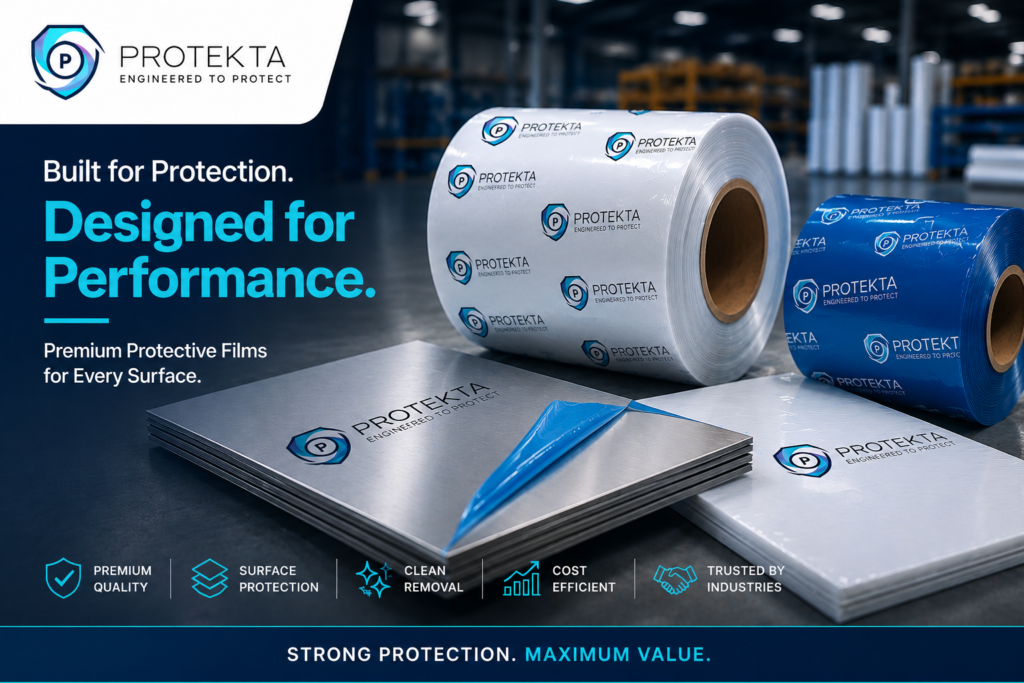
Buying protective films one roll at a time might work for a one-off project, but if you run a manufacturing line, fabrication shop, or distribution operation, that approach will quietly eat into your margins. The math changes fast when you scale up, and so does the way you need to think about sourcing.
This post breaks down how protective film manufacturers manage bulk supply without letting quality slip, what buyers should actually look for when placing large orders, and why the decisions you make at the procurement stage have a direct impact on production outcomes.
Why Bulk Protective Film Supply Makes Economic Sense
Let’s start with the basics.
When you buy wholesale protective films, you’re not just getting a price break on the per-roll cost. You’re also reducing procurement frequency, cutting down on freight charges per unit, and giving your production team a stable supply they can count on week to week.
Here’s what changes when you shift to bulk ordering:
-
- Per-unit cost drops because manufacturers price large runs differently than small orders. Raw material procurement, machine setup time, and logistics all get spread across more product.
-
- Supply chain disruptions shrink. A stockout on the production floor is expensive. Keeping buffer inventory means one delayed shipment doesn’t halt operations.
-
- Customization becomes viable. Many protective film manufacturers won’t accommodate custom thicknesses, adhesive grades, or print specifications on small orders. At bulk volume, those conversations open up.
-
- Supplier relationships deepen. Consistent large orders give you negotiating leverage and put you in line for priority production slots.
None of this means bulk ordering is always the right answer, but for businesses that use surface protection films regularly across glass, metal, plastic, or composite panels, the numbers tend to work in favor of wholesale.
How Protective Film Manufacturers Control Quality at Scale
This is where a lot of buyers get nervous. The concern is valid: does quality hold up when a manufacturer is pushing out thousands of rolls a month?
The short answer is that it depends entirely on the manufacturer’s production controls. Here’s what to look for.
Raw Material Consistency
Surface protection films are typically made from polyethylene (PE) or polypropylene (PP) substrates with an acrylic or rubber-based adhesive layer. At scale, the quality of incoming raw materials can vary between batches if the supplier isn’t monitoring it. Reputable industrial film suppliers source from consistent raw material vendors and run incoming quality checks before any material hits the production line.
Adhesive Coating Precision
The adhesive layer is the part that gets most people into trouble. Too little adhesion and the film lifts during transit or processing. Too much and you’re left with residue on the finished surface. Manufacturers managing bulk protective film supply use precision coating systems, often gravure or slot-die coating setups, that apply adhesive at a controlled and uniform thickness across the full roll width.
In-Line Quality Monitoring
Modern film extrusion lines use in-line thickness gauges and surface inspection cameras to catch defects before they become full rolls of unusable product. This matters more in bulk production because a calibration issue that goes undetected for two hours on a high-speed line is a significant write-off.
Roll Consistency and Winding
Inconsistent winding tension leads to telescoping rolls, which are rolls where layers shift and create handling problems at the customer’s site. Proper winding control ensures each roll in a bulk shipment performs identically on application equipment.
What to Evaluate When Choosing Wholesale Protective Film Suppliers
Not all industrial film suppliers are set up to handle bulk orders well. Some manufacturers are optimized for smaller, more frequent runs and lack the warehouse space, raw material procurement depth, or production capacity to support high-volume customers reliably.
Here’s what to check before committing to a supplier:
Production capacity. Ask specifically about monthly output capacity and lead times for repeat orders. A supplier who can fill your first order fast but takes six weeks for the second one is a logistics problem waiting to happen.
Customization range. If your products use multiple surface types, you may need films with different adhesive strengths, thicknesses, or widths. A supplier who can cover your full range under one roof simplifies procurement considerably.
Minimum order quantities (MOQs). Understanding the MOQ structure helps you plan order cycles. Some manufacturers tier pricing based on quantity, so knowing where the price breaks sit lets you make smarter purchasing decisions.
Technical support. A good protective film manufacturer doesn’t just ship product. They help you select the right film for your specific surface and application conditions. That includes guidance on adhesive type, peel strength, and film thickness based on what you’re protecting and for how long.
Traceability and documentation. For regulated industries or export markets, you may need batch documentation, material safety data, or certificates of conformance. Not every supplier provides these as standard.
Application-Specific Considerations for Bulk Buyers
Different surfaces need different films, and this isn’t just a technical detail — it’s a cost issue.
Using a film with higher adhesive strength than necessary means harder removal and a higher risk of residue. Using a film that’s too light means protection failures during processing or shipping. Neither outcome is cheap to fix once you’re dealing with it at scale.
For aluminum composite panels (ACP): These need films that hold firmly during cutting, routing, and fabrication but remove cleanly from the coated aluminum surface. The adhesive chemistry matters here because some standard films react poorly with certain coatings.
For stainless steel and metal surfaces: Scratch protection during fabrication and transit is the primary job. Films used here often need UV resistance if the steel will sit outdoors before installation.
For plastic and acrylic surfaces: These are more prone to surface damage from aggressive adhesives and require films specifically formulated for low-surface-energy materials.
For glass: Temporary surface protection during construction is common. Films here need to withstand weather exposure for extended periods without drying out or bonding too aggressively.
Protekta, based in Bhiwadi, Rajasthan, offers surface protection films across several of these categories, including the Protekta Guard line for general surface protection and the Protekta Bond series specifically designed for aluminum composite and partition panel applications. Their product range reflects the kind of application-specific thinking that bulk buyers actually need.
How Bulk Orders Are Typically Structured Between Buyer and Manufacturer
Once you’ve found a reliable supplier, understanding the order structure helps you avoid surprises.
Forecasting agreements. Many manufacturers offer better pricing when buyers commit to a quarterly or annual volume forecast, even if the exact delivery schedule stays flexible. This gives the manufacturer predictable production demand and gives the buyer price stability.
Blanket purchase orders. A blanket PO lets you lock in pricing for a defined volume over a period of time, with individual releases as needed. This is common in manufacturing procurement and works well for protective films because consumption is relatively predictable.
Consignment stock. For very high-volume buyers, some industrial film suppliers will maintain stock at or near the buyer’s facility. This is less common but worth discussing if stockouts are a recurring problem.
Sample and trial protocols. Before placing a large order, any serious supplier should offer sample rolls for qualification testing. This lets your team verify that the film performs correctly with your specific substrates, equipment, and processes.
Common Mistakes Buyers Make with Bulk Protective Film Orders
A few patterns come up repeatedly when bulk orders go wrong.
Choosing on price alone. A cheaper film that leaves residue, tears on application, or fails to protect during transit isn’t cheaper once you factor in rework, rejection, or customer complaints.
Not testing before scaling. A film that works fine on one surface type may behave differently on another. Always qualify new films on your actual production setup before committing to bulk volume.
Ignoring storage requirements. Protective films have shelf lives, and storage conditions matter. Films stored in high-temperature or high-humidity environments can see adhesive performance degrade before they’re even used. Ask your supplier for storage guidelines and plan your warehouse accordingly.
Overlooking lead times for custom specifications. If you need a specific width, thickness, or adhesive type, build extra lead time into your planning. Custom production runs require raw material procurement and line changeovers that take longer than standard products.
What the Right Bulk Supplier Looks Like
Pulling it all together, a supplier worth committing to at wholesale volume will typically offer:
-
- Consistent raw material sourcing with batch traceability
-
- In-line quality controls during production
-
- A clear range of products matched to specific surface types
-
- Transparent MOQ and pricing structures
-
- Technical guidance before and after the sale
-
- Reliable lead times for repeat orders
Protekta, backed by over 40 years of manufacturing experience from parent company Girdhar Roll Wrap, operates from a dedicated facility in Bhiwadi and serves businesses across multiple sectors. Their product range, from surface protection films to flexible packaging laminates, is built around the kind of industrial requirements that bulk buyers actually deal with.
Frequently Asked Questions
Q1: What is the minimum order quantity for bulk protective film purchases from most manufacturers?
MOQs vary by manufacturer and product type, but most industrial film suppliers set bulk thresholds starting from 500 kg to several tonnes depending on the specification. Custom widths or adhesive grades typically carry higher MOQs than standard products. Always confirm before requesting samples.
Q2: How do I know which protective film thickness is right for my application?
Thickness selection depends on the level of protection needed and the application method. Light fabrication protection typically uses 50–80 micron films. Heavier-duty applications like shipping and outdoor storage may need 100 microns or more. Your supplier’s technical team should walk you through this based on your specific surface and process.
Q3: Can protective films be customized for specific surface types in bulk orders?
Yes, most reputable protective film manufacturers offer customization options at bulk volume. This includes adjusting adhesive strength for low-surface-energy substrates, custom roll widths to match your equipment, and UV stabilization for outdoor applications. Custom orders typically require longer lead times than standard products.
Q4: What’s the shelf life of protective films, and how should they be stored?
Most surface protection films have a shelf life of 12 to 24 months when stored correctly. Keep rolls in a cool, dry environment away from direct sunlight and heat sources. Horizontal storage on racks prevents roll deformation. Always check the manufacturer’s specific storage recommendations as adhesive formulations vary.
Q5: How do manufacturers ensure consistent quality across large bulk shipments?
Quality consistency in bulk production depends on in-line monitoring during extrusion and coating, controlled raw material sourcing, and winding tension management. Established manufacturers use thickness gauges and surface inspection systems throughout production. Buyers can request quality documentation or certificates of conformance to verify batch-level consistency.