
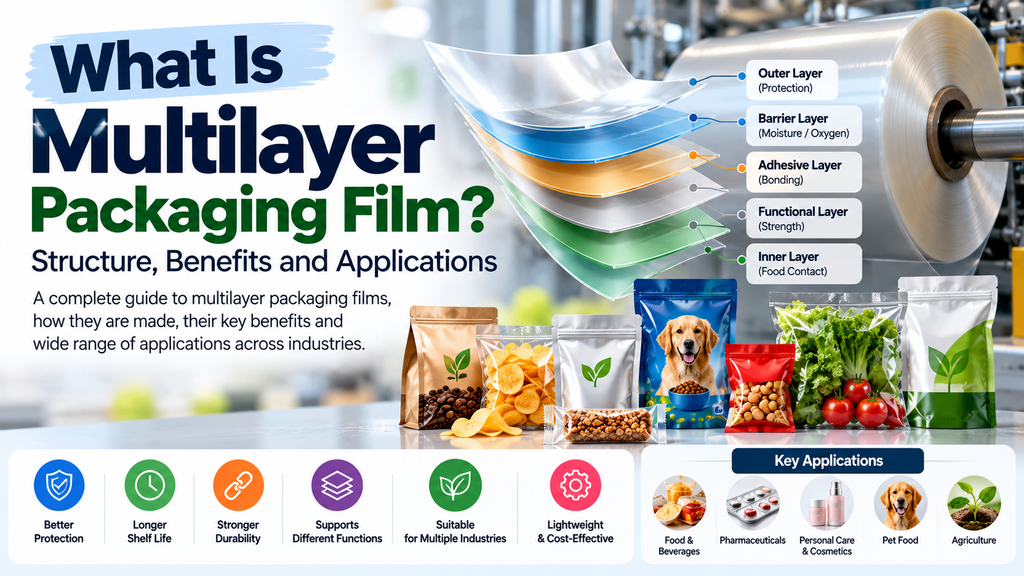
Pick up a bag of biscuits, a pouch of frozen peas, or a pack of cheese. The film around it often has more than one layer. Each layer does a different job, and together they guard the food against moisture, air, punctures, and leaks.
This guide explains what layered plastic packaging is, how the layers work, where brands use it, and what to check before you order. Let’s break it down.
What Is Multilayer Packaging Film?
Multilayer packaging film is a flexible plastic film made of two or more bonded layers. Each layer adds one property, such as strength, a moisture barrier, or a heat seal. Together, the layers often protect food better than any single material could.
A patent on polyethylene resins notes that these films usually contain from 2 to about 7 layers. Makers build them in one of two ways:
- Coextrusion: The layers form together in one process.
- Lamination: A second step bonds finished layers to other packaging materials.
Most flexible food packs use one of those two routes.
The Structure of a Layered Film: What Each Layer Does
Here is the short version of a typical structure, from outside to inside:
- Outer layer: gives the film shape and toughness.
- Barrier layer: slows the movement of gas and moisture.
- Tie layer: bonds layers that would not stick on their own.
- Sealant layer: forms the closed seal and touches the food.
One conventional liner for dry food, described in a US patent, stacks HDPE, a tie layer, nylon, another tie layer, and a sealant. That order runs from the outer layer to the inner layer. Real films vary, but the pattern holds.
The Outer Layer
The outer layer takes the wear of handling, shipping, and stacking. Patent claims for layered films list polyamide, polycarbonate, polyester, and polyolefin as outer layer options. The choice depends on how rough the supply chain is.
The Barrier Layer
This layer does the protective work. Ethylene vinyl alcohol (EVOH) shows up often in patent claims, sometimes placed between two polyamide layers.
Barrier thickness is not random. One patent explains that it depends on how sensitive the product is and how long the shelf life needs to be. A cracker needs a different barrier than a dairy dessert.
For dry foods in bag-in-box liners, another patent names the main attributes as moisture barrier performance and abuse resistance, meaning tear and puncture strength.
The Tie Layer
Some plastics refuse to bond. A trade article in Process Worldwide explains that materials with different chemistry do not fuse into one structure. They can separate, which engineers call delamination. A tie layer holds them together.
The European Patent Office describes tie-layer adhesives as anhydride-modified polyolefins. They bond polyolefins to dissimilar materials in coextruded films.
The Sealant Layer
The sealant is the innermost layer. A US patent says it should have minimal effect on the taste or color of the contents. It should also stay unaffected by the product and hold up under sealing conditions, including liquid droplets, grease, and dust. The same patent puts typical sealant layers at about 25 to 100 micrometres thick.
How Layered Films Are Made
Let’s break down coextrusion, since it is the most common route.
- Machines melt each polymer in a separate extruder.
- The molten streams join in a mixing block into one stream with several layers.
- That stream flows through a die and forms the film.
Process Worldwide names cast extrusion and blown extrusion as the two main methods. In cast extrusion, the polymer feeds pass through a feedblock that sets layer thickness. In blown extrusion, the molten film inflates into a tube.
Lamination adds one more step after extrusion. A patent on polyethylene compositions says a film may still be laminated to other packaging layers, depending on the final properties the pack needs. For fresh produce applications, MAP packaging can help provide the required barrier and sealing performance.
Benefits of Layered Packaging Films
Why do packers choose layers over a single sheet of plastic? Here is why:
- Protection that matches the product. You can set barrier thickness for the food and the shelf life you need.
- Strength where it counts. A tough outer layer resists tearing and punctures.
- Reliable seals. A dedicated sealant layer is built for the closing step.
- Design freedom. A 2021 review in Foods notes that this kind of food packaging has been highly customizable.
- Light weight and low cost. A dissertation from TU Wien notes that polymers allow lightweight, low-cost packs that protect sensitive food.
A multilayer film also lets one pack combine traits that no single polymer offers. That is the main reason food brands keep using them.
Applications of Multilayer Film
Layered films show up across food and dry goods. The Protekta product page lists these uses:
- Baked goods
- Dairy products
- Spices and dry goods
- Frozen foods
- Snacks
- Confectionery
The same page says films can suit liquids, powders, granules, or solids, depending on the build. Patents add dry food liners for bag-in-box packs.
Match the film to your product’s weak spots. Dry snacks fear moisture. Frozen meals need films that stay tough in the cold. Dairy needs clean seals.
Where Protekta Ply Fits
Protekta, the packaging brand of Girdhar Roll Wrap Ltd in Bhiwadi, Rajasthan, lists a film range called Ply. Here is what the product page states:
- The films come from blown film extrusion and use LDPE (low-density polyethylene).
- They suit dairy products, baked goods, frozen meals, dry snacks, and powders.
- They combine toughness, flexibility, transparency, and sealing properties.
- The page says they resist punctures, bending, and tearing.
- They work with automatic packaging equipment, and a low softening point lets them seal quickly, which cuts sealing time and energy use.
- The page says they meet food grade packaging requirements.
- Rolls come in custom thicknesses and sizes for form-fill-seal (FFS) machines.
The page does not publish layer counts or barrier data. Ask for those numbers before you place an order.
The same site also lists Flex, a range for strength, clarity, and sealing in snack and consumer packs. It lists Fresh too, a range of modified atmosphere films for fruits, vegetables, and ready-to-eat food.
Food Safety Rules in India
Food contact rules matter for any film that touches food. The Food Safety and Standards Authority of India (FSSAI) published a draft packaging regulation in October 2017. It defines “multilayer food packaging” as its own category. The draft also says:
- Plastic containers for food can use polyethylene that conforms to IS 10146.
- All plastic packaging must pass the prescribed overall migration limit.
- Printed surfaces must not touch food directly.
That document is a draft. Check the current notified rules, and ask your supplier for test reports that match them.
The Downside: Recycling
Layered films have one well-known weak spot. The Foods review says multilayer flexible food packaging is under pressure to redesign for recyclability. It also says these packs are hard to recycle and have low recycling rates.
The review cites an Ellen MacArthur Foundation estimate from 2017. About 26 weight percent of flexible packaging is multi-material, which equals around 10% of global plastic packaging.
A TU Wien dissertation explains why. Different polymers usually do not mix well, so mechanical recycling is hard. The Foods review adds that better recyclability often costs some packaging performance.
So weigh the trade-off. Ask whether a simpler structure can protect your product. If one can, it may recycle more easily.
How to Choose the Right Film: Next Steps
Follow this short checklist:
- Name what your product fears most, such as moisture, oxygen, or punctures.
- Set the shelf life you need.
- Ask for the layer structure and barrier data.
- Confirm the film fits your FFS or sealing machine.
- Request food contact test reports.
- Ask about recyclable options, from Protekta or any other supplier.
- Run a small trial before a full order.
Small trials cost little and catch most seal and shelf-life problems early. Multilayer packaging film works best when the structure fits the product, the machine, and the rules.
Frequently Asked Questions
How many layers does a layered packaging film have?
Most contain from 2 to about 7 layers, according to a US patent on polyethylene compositions. The count depends on what the film must do. A simple pack may need two layers. A film with a strong barrier may need more.
What does a tie layer do?
A tie layer bonds layers that would not stick on their own. Some plastics have different chemistry and separate if you place them together. The tie layer holds the structure in one piece and prevents delamination during storage and handling.
Is multilayer film safe for food?
It can be, if it meets food contact rules. In India, FSSAI’s 2017 draft packaging regulation calls for polyethylene conforming to IS 10146 and passing migration limits. Always ask your supplier for current test reports before using a film.
Can layered plastic film be recycled?
It is difficult. Different polymers do not mix well, so sorting and mechanical recycling are hard. Researchers are working on redesigns, including simpler structures. Ask your supplier whether a more recyclable build can still protect your product.
What should I ask a film supplier before ordering?
Ask for the layer structure, barrier data, seal strength, and available thicknesses. Check machine compatibility, such as FFS lines. Request food contact test reports. Then run a small trial with your own product before you order a full batch.