
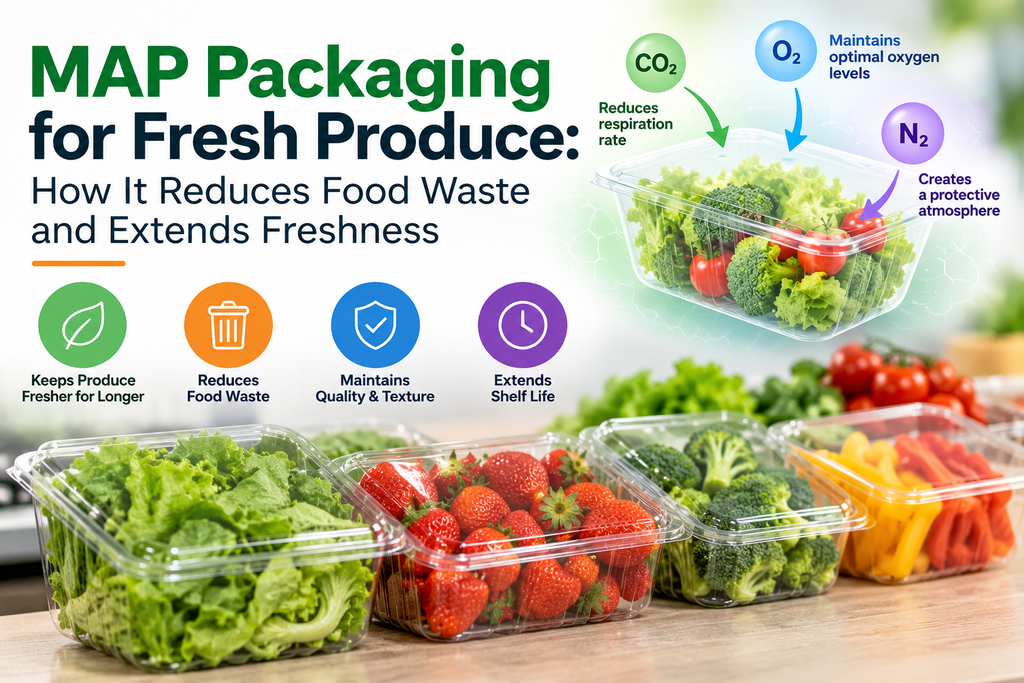
Walk through any fresh market and you will spot the same problems. Soft tomatoes, limp greens, and fruit with brown spots. That loss starts long before the shopper arrives. Produce stays alive after harvest, and it keeps aging on the way to the shelf.
MAP packaging for fresh produce slows that aging by changing the air around the food. This guide explains how it works, what it does for food waste, and how to pick the right film. Let’s break it down.
What Is Modified Atmosphere Packaging?
Modified atmosphere packaging (MAP) seals food in a pack where the gas mix differs from normal air. For fruits and vegetables, that usually means less oxygen and more carbon dioxide.
The lower oxygen level slows the produce’s natural aging. It also slows the microbes that cause spoilage. The result is food that stays fresh for more days.
The idea is not new. A 2015 review in Food Reviews International by Zhang and colleagues notes that the food industry had used MAP for about 90 years by then. The authors also describe newer systems, including high-oxygen, controlled, and intelligent MAP.
Here is the short version:
- MAP changes the gas mix inside a sealed pack.
- Less oxygen and more carbon dioxide slow aging and spoilage.
- It works best together with cold storage.
Why Fresh Produce Spoils So Quickly
Fruits and vegetables do not stop breathing when someone picks them. An open access chapter on MAP design explains that plant cells keep using oxygen and releasing carbon dioxide after harvest. Temperature, oxygen, carbon dioxide, ethylene, and water vapor all shape how fast produce ripens and breaks down.
A 2010 review in LWT – Food Science and Technology adds another point. Breathing rates rise after harvest, which makes fresh produce more open to disease organisms.
So the clock starts at harvest. Every hour of warm, open-air handling speeds it up.
What the Loss Looks Like in India
The Ministry of Food Processing Industries commissioned a national study through NABCONS in 2022. The Ministry shared results in the Rajya Sabha in August 2023. Fruit losses ranged from 6.02% to 15.05%. Vegetable losses ranged from 4.87% to 11.61%.
A February 2025 Rajya Sabha reply put annual losses at 7.36 million tonnes of fruit and 11.97 million tonnes of vegetables. Trade publication FreshPlaza reports that guava had the highest fruit loss at 15.05%. The study looked at harvesting, grading, packaging, transport, storage, and retail.
Those numbers cover the whole chain. Packaging is one part of the fix, not the whole fix. It is still a part you can control.
How MAP Extends Freshness, Step by Step
Here is why a sealed pack can hold produce longer. The process runs in five steps:
- Seal the produce. Packers place the produce in a tray, pouch, or container and seal it with a film that lets gas pass at a measured rate.
- The produce breathes. It uses up oxygen and releases carbon dioxide inside the pack.
- The gas balance settles. The film lets some gas escape, so the pack reaches a steady, low-oxygen mix.
- Aging slows. Lower oxygen and higher carbon dioxide slow respiration and microbial growth.
- Cold storage adds to the effect. Lower temperatures slow the same processes further.
Real numbers help here. Normal air holds about 21% oxygen and 0.03% carbon dioxide. Modified atmosphere packaging and how it extends shelf life Professor David O’Beirne of the University of Limerick told The Irish Times that a well-matched salad pack holds oxygen near 3% and lets carbon dioxide climb to about 5%. He put the refrigerated shelf life of that product at around five days.
The 2010 LWT review says the recommended oxygen level for fruits and vegetables falls between 1% and 5%. The open access chapter also reports that in the broccoli and cauliflower studies it covers, shelf life rose from 40% to twice that under normal air.
Results vary by produce type, gas mix, and storage temperature. Treat these figures as examples, not promises.
How MAP Packaging Reduces Food Waste
Waste builds up at every handoff. Produce moves from farm to sorting, then to transport, storage, retail, and finally a kitchen. Each step uses up some shelf life.
A 2006 review in the Stewart Postharvest Review by Artés and colleagues looked at this chain. The authors found that MAP combined with refrigeration helps keep quality and safety across handling, storage, transport, distribution, and retail sale. They link it to a reduction in both quality losses and quantity losses.
In practical terms, extra days of freshness do three things:
- Retailers get more time to sell a pack before it turns.
- Transporters get more room for delays.
- Households get more time to eat what they buy.
Fewer discarded packs also means less wasted water, labor, and energy that went into growing the food.
How to Choose Fresh Produce Packaging Film
The film decides whether the pack works. A poor match can do more harm than good. Let’s break down what to check.
Match the Film to the Produce
Every fruit and vegetable breathes at its own rate. The film must let gas through at a speed that fits.
Professor O’Beirne warned about the risk. If the packaging is too impermeable, the pack loses all its oxygen. An inappropriate material produces an inappropriate atmosphere. That can spoil food faster, not slower.
Ask your film supplier for permeability data. Then test it with your own produce at your own storage temperature.
Check Seal Strength and Barrier Performance
A MAP pack only works if the gas mix stays put. A weak seal leaks, and the benefit disappears. Look at how well the film seals to your tray or container. Also check how well it resists moisture and gas movement.
Plan for Moisture and Temperature
Artés and colleagues flag a real downside. Temperature swings can cause water to condense inside a pack. MAP can also slow how fast the product cools. Keep the cold chain steady and cool produce before sealing it.
Where Protekta Fits In
Protekta sells flexible packaging and protection films made by Girdhar Roll Wrap Ltd in Bhiwadi, Rajasthan. Its Protekta Fresh range covers modified atmosphere packaging films. The Protekta Fresh product page lists fresh vegetables and fruits among the applications. It also lists ready-to-eat food trays, dairy and cheese, meat, and bakery items.
The page names five film types:
- MAP Sealing Film: for tight sealing of containers or trays.
- MAP Barrier Lidding Film: for better moisture and oxygen barrier.
- MAP Barrier Sealing Film: for strong seals and maximum protection.
- Sealing Film: an all-purpose film with clarity and strength.
- Easy Peel Lidding Film: for clean, simple opening.
According to the page, the multilayer films manage oxygen and moisture, resist gas, aroma, and moisture movement, and work on trays, containers, or pouches. The page also says they suit hot-fill, cold-fill, and vacuum-sealed uses. Test any film with your own produce before you commit to a full run.
What MAP Cannot Do
MAP is not magic. Be clear about its limits before you rely on it.
- It does not replace cold storage. Warm produce in a sealed pack can still spoil.
- It can slow cooling. Artés and colleagues list slower cooling as a known drawback.
- Some fruits ripen abnormally under certain atmospheres, according to the same review.
- Safety questions remain for some gas mixes. A 2006 review of fresh-cut fruit by Martín-Belloso and Soliva-Fortuny found that the effect of some atmospheres on food-borne pathogens is uncertain.
Good hygiene, clean handling, and temperature control still come first. MAP adds to them.
Next Steps
Ready to put this to work? Follow this short plan:
- List the produce you pack and its normal shelf life today.
- Check the recommended oxygen and carbon dioxide range for each item.
- Ask film suppliers for permeability and seal data.
- Run a small trial at your real storage temperature.
- Track spoilage, condensation, and seal failures for each batch.
- Adjust the film or pack size, then scale up.
Small trials cost little and catch most problems early. MAP packaging for fresh produce pays off when the film, the produce, and the cold chain all fit together.
Frequently Asked Questions
How long does MAP keep fresh produce fresh?
It depends on the produce, the gas mix, and the storage temperature. One open access review reports shelf life gains from 40% to twice normal for broccoli and cauliflower. A refrigerated salad pack lasts about five days, according to one Irish expert.
Is MAP safe for fresh fruits and vegetables?
MAP is widely used, but it does not replace good hygiene or cold storage. Research shows some gas mixes have uncertain effects on food-borne pathogens. Producers should test their packs and keep strict handling standards.
Does MAP replace refrigeration?
No. Studies describe MAP working together with refrigeration, not instead of it. Cold temperatures slow the same aging processes that low oxygen targets. Without cooling, spoilage and condensation problems can grow inside the pack.
Which gases does MAP use for fruits and vegetables?
Oxygen, carbon dioxide, and nitrogen are used most often. A 2010 review says the recommended oxygen level for produce sits between 1% and 5%. Other gases have been studied but face safety, regulatory, and cost limits.
What should I look for in a fresh produce packaging film?
Look for gas permeability that suits your produce, strong seals, and good moisture barrier performance. Check that the film fits your trays, pouches, or containers. Then run a trial at your real storage temperature before scaling.