
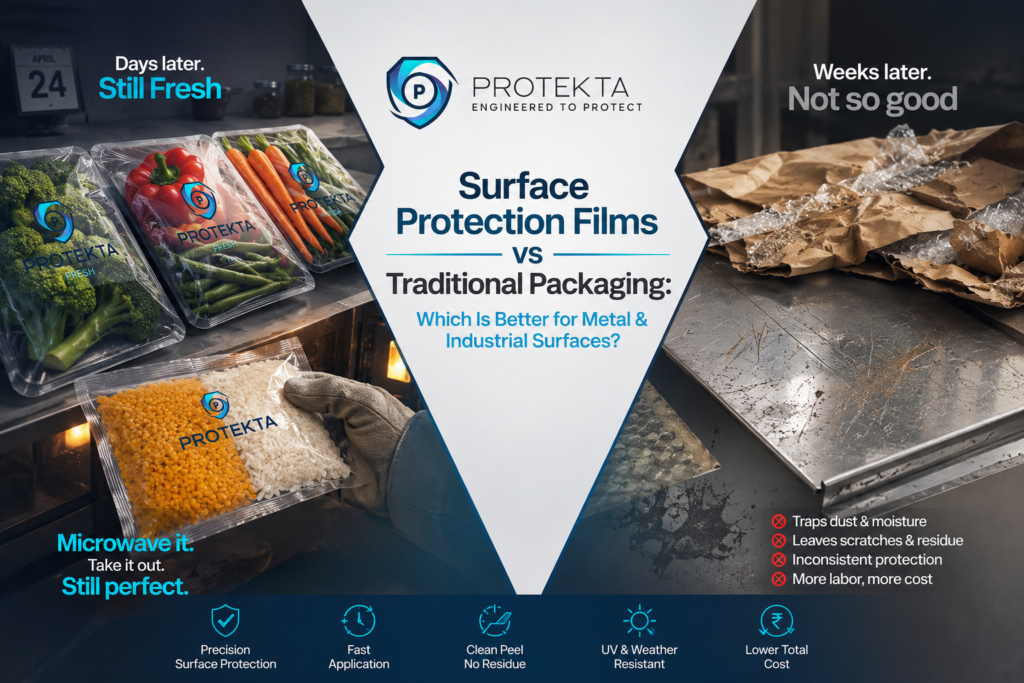
If you work in manufacturing, construction, or fabrication, you already know how much a scratched panel or a scuffed stainless steel sheet can cost you. Damage during transit or installation is not just a minor inconvenience – it means rejected consignments, rework expenses, and unhappy clients. So the question most procurement managers and plant heads eventually ask is this: should you stick with traditional packaging materials, or is it time to move to purpose-built surface protection films?
Let us look at both options honestly, compare them on the factors that actually matter, and help you make a clear-headed decision.
What Is Traditional Packaging for Metal and Industrial Surfaces?
Traditional packaging covers materials that have been used in industrial shipping and storage for decades. This includes craft paper, cardboard wrapping, corrugated sheets, foam padding, bubble wrap, cloth blankets, and stretch wrap.
These materials are general-purpose. They were designed to cushion and contain – not specifically to protect finished surfaces. When a fabricator wraps a stainless steel sheet in kraft paper or tucks foam between aluminium panels, the goal is usually just to prevent movement during transit.
Here is where things fall short:
- Craft paper can trap grit and slide against polished metal, causing fine scratches
- Foam padding absorbs moisture and can leave residue or lint behind
- Bubble wrap is bulky, difficult to apply uniformly, and usually secured with tape that leaves adhesive marks
- Cloth blankets accumulate dust and contaminants between uses
- Stretch wrap applied directly to bare metal or anodised aluminium can bond to the surface over time, especially in warm conditions
The fundamental problem is that none of these materials were engineered with the surface in mind. They protect the product from impact and movement, but they can themselves become a source of surface damage.
What Are Surface Protection Films, and How Do They Work?
Surface protection films are thin, self-adhesive films engineered specifically to bond gently with a target surface and peel off cleanly once protection is no longer needed. They typically use polyethylene (PE), polypropylene (PP), polyvinyl chloride (PVC), or polyolefin as the base substrate, with a pressure-sensitive adhesive on the reverse side.
The adhesive is formulated to hold firmly during handling, transit, and installation – but release cleanly without leaving ghosting, sticky residue, or damage when removed.
Different variants are designed for different surfaces. A protective film for metal surfaces needs a different adhesive profile than one used on glass or painted composites. Films for outdoor or construction applications are formulated with UV stabilisers so they do not yellow, crack, or bond permanently when left in sunlight for weeks.
A surface protection film manufacturer calibrates three things for each film type: adhesion strength, film thickness, and UV resistance. Getting these wrong means the film either falls off during use or refuses to come off cleanly at the end.
Head-to-Head: Where Surface Protection Films Pull Ahead
1. Precision Surface Protection for Stainless Steel and Aluminium
Polished stainless steel and brushed aluminium are among the most damage-prone surfaces in industrial settings. Even a thin layer of grit trapped between kraft paper and a mirror-finish surface causes micro-scratches that are nearly impossible to reverse without refinishing.
Surface protection film for stainless steel is applied directly from a roll onto the surface, without any intervening material that could trap contaminants. The adhesive contacts only the surface – and a good-quality film will not scratch or mark it. When peeled off, the surface looks exactly as it did at the start.
Protection film for aluminium sheets works the same way. Whether the aluminium is anodised, powder-coated, or bare, the right film grade bonds cleanly and releases without marking the finish. Composite panel manufacturers and aluminium processors have largely moved away from craft paper for this reason.
2. Application Speed and Labour Costs
Traditional packaging is labour-intensive. Wrapping large metal sheets or ACP panels in foam and paper requires multiple workers, takes time, and produces inconsistent results depending on who is doing the wrapping.
Surface protection films come on rolls and apply quickly – by hand or, in high-volume facilities, by automated applicators. One person can cover a large panel in a fraction of the time it takes to wrap the same panel in conventional material. In production environments where thousands of sheets move through daily, this matters.
3. Consistent, Predictable Protection
One of the underrated advantages of protection films is consistency. Every metre of film from a quality roll behaves the same way. Adhesion, thickness, and peel performance are uniform. With foam or paper, the quality of protection depends entirely on the skill of the person applying it and the condition of the material being used.
For manufacturers supplying clients with strict quality standards, that consistency is not optional.
4. No Residue, No Rework
Tape used to secure traditional packaging is one of the most common sources of surface contamination in industrial settings. Adhesive residue from packaging tape on a finished metal surface requires solvent cleaning, which adds time and risk.
A properly specified surface protection film leaves nothing behind. Peel it off, dispose of it, and the surface is ready. No solvents, no scrubbing, no additional cleaning step.
5. Outdoor Weather Resistance
Construction sites, fabrication yards, and logistics depots store materials outdoors for weeks or months. Craft paper turns to pulp. Foam deteriorates and traps moisture. Cloth gets dirty and retains that contamination.
Quality protection films for industrial surface protection solutions handle outdoor exposure well. Films with UV stabilisers can remain on surfaces for several months without degrading, yellowing, or bonding permanently. They resist rain, dust, and temperature fluctuation – which is more than paper or foam can honestly claim.
Where Traditional Packaging Still Has a Role
Traditional packaging is not entirely obsolete. It still makes sense for heavy impact protection during freight where cushioning against physical blows is the primary concern – think large castings being shipped across state lines on flatbed trucks. Foam and corrugated cardboard absorb physical shocks in a way that thin film cannot.
Where surface finish is the priority, traditional materials are consistently outperformed.
Glass Protection Film: A Specific Case Worth Highlighting
Glass requires a level of care that most packaging materials cannot provide. A glass protection film must be transparent (so installers can check alignment during installation), resistant to construction-site chemicals, and clean-peeling even after months on site.
Craft paper on glass does none of this. It blocks the surface from view, can trap moisture, and when wet, turns into a mash of fibres that is difficult to remove. On large architectural glass panels, this creates serious practical problems.
Glass protection films designed for construction applications address all of these issues. They protect against scratches, paint splatter, cement, and adhesive contamination, while remaining transparent and peeling off cleanly at the end of the project.
How to Choose the Right Surface Protection Film
Getting this right comes down to matching the film specification to the surface type and use case. Here is a straightforward framework:
- Identify the surface: Stainless steel, bare aluminium, anodised aluminium, painted metal, glass, ACP, or plastic – each needs a specific adhesive profile.
- Determine the duration: Films used for a few days during transit have different requirements from those left on a panel for three months during construction.
- Assess environmental exposure: Is the surface stored indoors or outdoors? Will it face UV, moisture, or temperature extremes?
- Check removal timing: The longer a film stays on, the more important the adhesive chemistry becomes. A film that peels cleanly at 30 days may bond permanently at 180 days if not UV-stabilised.
Working with a reliable surface protection film manufacturer who can advise on the right grade for each application makes this process straightforward.
What Protekta Offers for Industrial Surface Protection
Protekta is a surface protection film manufacturer based in Bhiwadi, Rajasthan, operating under the two-decade legacy of Girdhar Roll Wrap. Their product range includes dedicated solutions for industrial and construction needs.
The Protekta Guard line covers general-purpose surface protection films for metal, glass, and plastic surfaces – available as self-adhesive film rolls and adhesive film in multiple grades.
The Protekta Bond ACP is designed specifically for aluminium composite panel protection, covering the material from manufacturing through transport to final installation. It addresses UV exposure, scratch resistance, and clean removal after extended outdoor use.
The Protekta Bond APP handles aluminium partition panels, providing temporary surface protection film suited to interior architectural applications where clean peel performance is non-negotiable.
All Protekta products are manufactured with an emphasis on residue-free removal, consistent adhesion, and weather resistance – which are the three factors that matter most to fabricators, contractors, and logistics managers. You can explore the full range at protekta website.
The Cost Argument: Films Are Not the Expensive Option
Surface protection films appear more expensive per roll than a packet of kraft paper or a foam sleeve. The actual cost comparison, when you factor in total cost of ownership, tells a different story.
Reworking a scratched stainless steel panel costs far more than a roll of film. Rejected shipments due to surface damage result in replacement costs, freight costs, and delay penalties. Labour hours spent wrapping and unwrapping traditional packaging add up over weeks and months.
Films reduce waste, reduce rework, reduce labour time, and reduce customer complaints. Over a full production cycle, they typically cost less – not more.
Frequently Asked Questions (FAQs)
Q1. What is the difference between surface protection film and bubble wrap for metal surfaces?
Bubble wrap cushions against impact but does not protect the metal surface itself from scratches or contamination. Surface protection film bonds directly to the surface, creating a barrier against scratches, dust, and chemical contact. For finished metal surfaces, film is the more appropriate choice.
Q2. Can surface protection film for stainless steel be used outdoors?
Yes, films formulated with UV stabilisers can be used outdoors for extended periods, typically up to six months, without yellowing, cracking, or bonding permanently. Always check the film’s UV resistance rating and the manufacturer’s recommended removal timeframe before outdoor use.
Q3. Will protection film for aluminium sheets leave adhesive residue?
A properly specified film, matched to the aluminium surface type and removed within the recommended period, will not leave residue. Choosing the right adhesive grade for the surface finish and avoiding overlong application times are the keys to clean removal.
Q4. How do I choose between different surface protection film grades?
The main factors are surface type, duration of protection, and environmental conditions. A film for stainless steel in a warehouse setting needs a different profile than one for ACP panels on an outdoor construction site. Consulting with your surface protection film manufacturer before purchasing ensures you get the right specification.
Q5. Is glass protection film suitable for construction sites?
Yes. Glass protection films designed for construction use are transparent, weather-resistant, and formulated to resist cement, paint splatter, and adhesive contamination. They peel off cleanly even after months on site, making them well-suited to glazing projects where installation and finishing work happens around the glass.