
Packaging is no longer just about wrapping something in plastic and hoping for the best. For modern businesses, the right food packaging solution is the difference between a product that arrives intact and one that doesn’t make it past the warehouse floor. Whether you’re shipping furniture panels, sending out fresh produce, or running a food manufacturing line, what you wrap your product in matters as much as the product itself.
This guide breaks down the types of packaging solutions businesses rely on today, what the materials actually do, and how to match the right film or laminate to your specific need.
Why Smart Packaging Materials Are Worth the Investment
Let’s start with the basics. Packaging failures cost money in three ways: damaged goods, unhappy customers, and wasted materials. Research from the Packaging Machinery Manufacturers Institute shows that product damage during transit is one of the top sources of supply chain losses for manufacturers.
The shift toward performance-driven packaging materials, including multi-layer films, surface protection films, and modified atmosphere films, comes from a clear need: standard packaging often doesn’t cut it when products face temperature swings, rough handling, or extended storage.
Here is why material choice matters. A film that’s too thin tears during application. One without the right adhesive chemistry leaves residue on the surface it’s meant to protect. And packaging without proper barrier properties lets moisture or oxygen degrade your product before it ever reaches the end user.
Getting this right from the start saves businesses from the downstream cost of product returns, reprocessing, and reputation damage.
Types of Packaging Solutions Used in Industrial and Food Applications
Surface Protection Films for Industrial Panels
Surface protection films are pressure-sensitive films applied directly to materials like aluminum composite panels, glass, steel, or laminates to prevent scratches, dust, and mechanical damage during manufacturing, transport, and installation.
How they work: The film bonds to the surface through a low-tack adhesive, stays in place through the entire production and handling process, and then peels off cleanly without leaving any adhesive residue.
Where they’re used: – Aluminum composite panel (ACP) fabrication and cladding – Aluminum partition panel (APP) manufacturing – Furniture panels and decorative surfaces – Construction and interior fit-out projects
The key performance criteria to look for in a surface protection film are peel adhesion strength, elongation at break, UV resistance for outdoor applications, and clean removal without ghosting or residue.
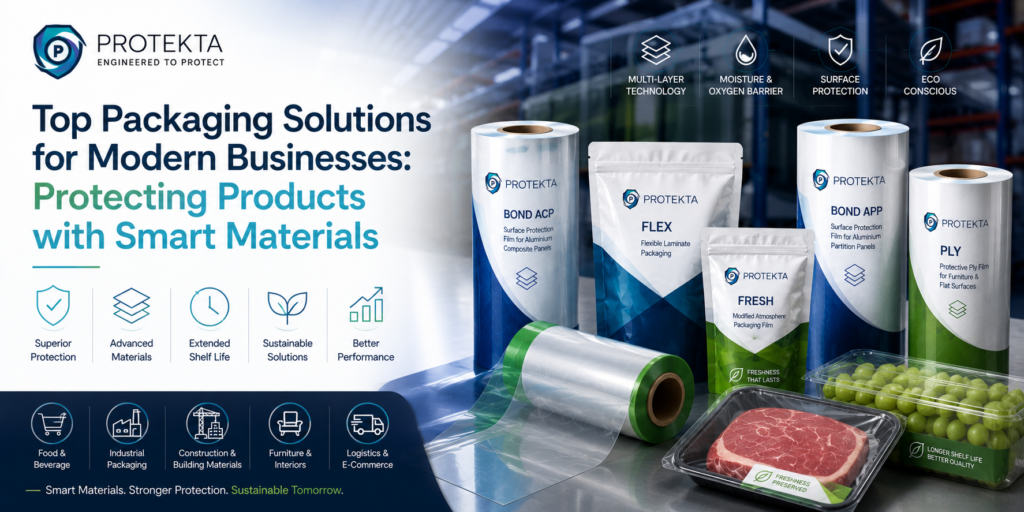
Protekta, based in Bhiwadi, Rajasthan, manufactures surface protection films specifically for ACP and APP applications under its Protekta Bond ACP and Protekta Bond APP product lines, along with Protekta Guard films designed for broader scratch and dust protection across surfaces.
Flexible Laminate Packaging Films
Flexible laminate packaging is one of the fastest-growing segments of the global packaging industry. According to data from the Flexible Packaging Association, flexible packaging accounts for a significant portion of all food and consumer goods packaging in use today because it offers a high strength-to-weight ratio and can be engineered for specific barrier requirements.
What makes flexible laminates “smart”:
Multi-layer flexible laminates combine different polymer layers, each contributing a specific property. A common food-grade laminate might combine:
- An outer layer of biaxially oriented polypropylene (BOPP) or polyethylene terephthalate (PET) for structural strength and printability
- A middle barrier layer to block oxygen, moisture, or odor
- An inner sealant layer (polyethylene or cast polypropylene) for heat sealing
This layered architecture lets manufacturers tailor the packaging to the product. Snack foods need a high-oxygen barrier to prevent rancidity. Frozen products need a film that stays flexible at low temperatures without cracking. Liquids need a robust seal integrity.
Protekta Flex is designed for exactly this kind of application, covering both food products and industrial uses where clarity, strength, and sealing consistency are required.
Modified Atmosphere Packaging (MAP) Films for Fresh Foods
This is where packaging science gets particularly interesting for food businesses. Modified atmosphere packaging extends the shelf life of perishables by altering the gas composition inside the sealed pack, replacing oxygen with a controlled mix of gases like carbon dioxide and nitrogen.
Here is how it works: By reducing the oxygen content inside a food pack, MAP films slow down oxidation and aerobic microbial growth, two of the main causes of spoilage. The packaging film itself needs to be engineered to maintain this controlled atmosphere, which means it must have precise gas permeability properties matched to the specific food product.
According to research published by the Institute of Food Technologists, MAP can extend the shelf life of fresh meat, produce, and ready-to-eat meals by two to five times compared to standard packaging, depending on the product and conditions.
Key applications: – Fresh fruits and vegetables – Cut salads and herbs – Ready-to-eat meals – Fresh meat and seafood
Protekta Fresh is built specifically for this segment, targeting produce, fruits, vegetables, and ready-to-eat food products that need reliable freshness preservation from packing through to consumption.
Protective Ply Films for Furniture and Flat Surfaces
Furniture manufacturers and panel fabricators deal with a specific challenge: large flat surfaces that pick up scratches, pressure marks, and dust just from being moved around a facility. Standard stretch wrap doesn’t protect the surface itself, it just holds things together.
Protective ply films are a purpose-built answer. They adhere directly to the surface, provide a physical barrier against impact and abrasion, and release cleanly during installation or before the product reaches the end customer.
Protekta Ply addresses this exact application, designed for furniture and flat surfaces where surface finish quality directly affects the final product value.
How to Match Packaging Solutions to Your Business Needs
Not every business needs the same film type. Here is a simple decision framework:
Are you protecting a manufactured surface from damage during handling or transit? Look at surface protection films (ACP, APP, or general-purpose guard films). Evaluate adhesive strength, film thickness, and whether you need UV stability for outdoor exposure.
Are you packaging food or consumer goods? Flexible laminate films are your primary option. Define the barrier requirements of your product first: oxygen barrier, moisture barrier, aroma retention. Then match the film structure to those needs.
Are you packaging fresh or perishable items with a short natural shelf life? Modified atmosphere packaging films can significantly extend shelf life and reduce food waste. This requires working with a supplier who understands both the film specifications and the gas flushing process.
Are you a furniture or panel manufacturer dealing with surface damage during production and delivery? Protective ply films and surface protection films should be part of your production workflow from day one.
What to Look for in a Packaging Film Manufacturer
Whether you’re sourcing packaging solutions for the first time or switching suppliers, a few things are worth checking:
Manufacturing consistency: Film properties need to be uniform roll to roll. Variations in thickness, adhesion, or clarity cause production line problems and surface quality issues.
Customization: Most industrial applications have specific requirements for width, thickness, adhesion level, and core size. A manufacturer that offers only off-the-shelf sizes will create limitations.
Application knowledge: The best packaging film manufacturer isn’t just a converter. They understand how their material behaves in your specific process, whether that’s a high-speed packaging line, a panel fabrication setup, or a cold chain food application.
Recyclability and environmental responsibility: With packaging regulations tightening in India and globally, having a supplier with a recycling or sustainability program matters more than it used to.
Protekta, backed by over 40 years of manufacturing history through its parent company Girdhar Roll Wrap, operates from a facility in Bhiwadi with a plastic recycling operation as part of its production process. Their product range spans both surface protection and flexible food packaging, making them a relevant option for businesses operating across industrial and food packaging categories.
Quick Reference: Packaging Film Types and Their Applications
| Film Type | Best For | Key Properties |
| ACP/APP Protection Film | Aluminum panels, architectural cladding | Strong adhesion, clean peel, UV stability |
| Guard Film | General surface protection | Scratch resistance, dust barrier, easy removal |
| Ply Film | Furniture, flat panels | Impact resistance, clean removal |
| Flexible Laminate (Flex) | Snack foods, consumer products | High barrier, seal integrity, clarity |
| MAP Film (Fresh) | Produce, ready-to-eat, fresh food |
Gas permeability control, shelf life extension |
Frequently Asked Questions
Q1: What is the difference between surface protection film and regular stretch wrap?
Surface protection films use a pressure-sensitive adhesive that bonds directly to the product surface, protecting it from scratches, dust, and impact without leaving residue. Stretch wrap simply bundles items together and doesn’t protect the surface finish itself.
Q2: How do I know what thickness of packaging film to use for my product?
Thickness (measured in microns) affects tear resistance, puncture resistance, and handling ease. Heavier, sharper products need thicker films. Your packaging film supplier should recommend a thickness based on your specific product weight, surface type, and handling conditions.
Q3: Can flexible packaging films be used for both food and non-food applications?
Yes, but the film specifications differ. Food-grade flexible films must comply with food contact regulations and use approved materials. Non-food industrial laminates may use different polymer compositions that are not cleared for food contact. Always confirm food compliance with your supplier.
Q4: What is modified atmosphere packaging and how long does it extend shelf life?
Modified atmosphere packaging (MAP) replaces the air inside a sealed food pack with a controlled gas mixture, usually CO2 and nitrogen, to slow spoilage and oxidation. Depending on the food type, MAP can extend shelf life by two to five times compared to standard packaging in ambient air.
Q5: What should I check when sourcing industrial packaging solutions from a new supplier?
Start with product specifications: film thickness tolerance, adhesion values, peel strength, and material composition. Ask for test rolls before committing to a full order. Confirm that the supplier can handle custom sizes for your production line and that their quality checks are documented consistently.