
Walk through any warehouse, food processing plant, or construction site and you will notice something that rarely gets talked about: packaging is doing a lot more work than it used to. It is not just wrapping a product anymore. Today, it is regulating atmosphere, resisting moisture, absorbing mechanical stress, and protecting high-value surfaces from factory floor to final installation.
Packaging companies, especially those focused on flexible packaging and surface protection, are investing heavily in materials science, multilayer film engineering, and application-specific design. This post breaks down exactly what is changing, why it matters, and what the best solutions look like across industries.
Why Flexible Packaging Is Replacing Rigid Formats Across Industries
Rigid packaging, think glass jars and metal cans, served industries well for decades. But the math has shifted. Flexible packaging uses significantly less raw material per unit, reduces transport weight, and cuts down on storage space. According to the Flexible Packaging Association, flexible formats can use up to 60% less energy to produce compared to rigid alternatives.
Here is why manufacturers are making the switch:
- Lighter weight reduces shipping costs and carbon emissions per delivery
- Multilayer film constructions allow oxygen barriers, moisture control, and aroma retention in one structure
- Resealable and portion-friendly formats improve consumer convenience
- Shorter lead times for custom sizes and print runs compared to molded rigid containers
For food manufacturers, the performance gains are even more concrete. Modified Atmosphere Packaging (MAP) films, for example, change the gas composition inside a sealed pack to slow microbial growth and extend product freshness without any added preservatives.
The Science Behind Modern Flexible Packaging Materials
Let’s break it down. Most performance flexible packaging is built from laminated film structures: multiple layers of different polymers, each contributing a specific property to the final material.
Modified Atmosphere Packaging Films for Fresh Food
MAP films are engineered to control gas permeability. A typical fresh produce or meat application requires precise oxygen transmission rates (OTR) and carbon dioxide transmission rates (CO2TR) to keep the internal atmosphere stable. Polyethylene, EVOH (ethylene vinyl alcohol), and polypropylene are commonly combined in these structures.
The result is a measurable increase in shelf life. A 2023 study published in the journal Food Packaging and Shelf Life found that MAP packaging extended fresh-cut vegetable shelf life by 3 to 5 days compared to conventional packaging under identical storage conditions. That reduction in food waste translates directly to lower costs for distributors and retailers.
Industrial Laminate Films for Food and Non-Food Applications
Outside of fresh food, laminate films serve a wide range of industrial packaging needs, from snack food sachets to pharmaceutical blister packs. The key variables are seal strength, puncture resistance, and barrier performance against moisture and UV.
Flexible packaging manufacturers now offer application-specific laminate constructions, meaning the film is engineered for a particular product and filling environment. A dry powder filling line has different requirements than a liquid or retort application, and modern laminate solutions can be tuned accordingly.
Protective Packaging for Industrial Surfaces: What Has Changed
Surface protection film is a category that does not get as much attention as food packaging, but it is just as technically demanding. Industries handling aluminium composite panels (ACP), aluminium partition panels, polished metal surfaces, and glass need temporary protective films that do three things well: adhere reliably during fabrication and transit, protect against scratches and abrasion, and remove cleanly without leaving adhesive residue.
Getting all three right is harder than it sounds. The adhesive chemistry has to be matched to the surface energy of the substrate. Too aggressive an adhesive and you get residue; too light and the film lifts during cutting or forming operations.
Aluminium Composite Panel Protection Films
ACP is widely used in building facades, signage, and interior fit-outs. The painted or coated surface is susceptible to scratching during cutting, routing, and installation. A good ACP protection film needs to conform to the panel surface, resist tearing during CNC operations, and release cleanly when the installation is complete.
Polyethylene-based surface protection films, typically coated with a low-tack acrylic adhesive, are the standard solution. Thickness usually ranges from 40 to 100 microns depending on the level of mechanical protection required.
Aluminium Partition Panel Protection Films
Aluminium partition panels used in office and commercial fit-outs have a slightly different protection requirement. The surfaces are often anodized or powder-coated, with a higher surface energy than ACP. Films for this application need to balance adhesion with clean removal, particularly in long-duration storage or transit scenarios where the film may be on the surface for weeks or months before installation.
How Flexible Packaging Manufacturers Are Addressing Sustainability
Sustainability has moved from a marketing talking point to an engineering requirement. Buyers across food, pharma, and construction are asking for documentation: recycled content percentages, certifications, carbon footprint data, and end-of-life disposal guidance.
Leading packaging companies are responding with a few distinct approaches:
- Mono-material flexible films that are easier to recycle than traditional multilayer laminates using dissimilar polymers
- Post-consumer recycled (PCR) content blended into film structures without sacrificing mechanical performance
- On-site plastic recycling facilities that reclaim production waste rather than sending it to landfill
- Downgauging (reducing film thickness) while maintaining performance, which reduces overall polymer consumption per unit
Protekta, a flexible packaging and protection film manufacturer based in Bhiwadi, Rajasthan, operates an in-house plastic recycling facility as part of its manufacturing process. This kind of integration at the production level reduces waste generation and reflects a broader shift in how responsible manufacturers are approaching material stewardship.
What to Look for When Evaluating Flexible Packaging Manufacturers
If you are sourcing flexible packaging or surface protection films, the product spec sheet is just the starting point. Here is what actually separates reliable manufacturers from the rest:
- Application-specific engineering: A manufacturer who asks about your filling process, storage conditions, and surface substrate before quoting is doing the right work.
- Quality consistency: Roll-to-roll uniformity in film thickness, seal strength, and adhesive coat weight matters enormously in automated packaging lines.
- Lead time reliability: Packaging delays shut down production lines. Ask specifically about average delivery time and what happens when demand spikes.
- Technical support: Can the manufacturer troubleshoot seal failures or adhesion problems on your specific equipment? This kind of practical support is worth a lot.
- Manufacturing transparency: Facilities that let you audit quality processes and supply chain documentation are lower-risk partners.
Real-World Applications of Protective and Flexible Packaging Solutions
The best way to understand how these materials perform is to look at where they are being used:
Fresh Food and Produce Packaging
Retailers and food service distributors use MAP packaging films for fresh salads, cut vegetables, meat, and seafood. The controlled atmosphere inside the pack slows down respiration and bacterial activity, allowing products to stay shelf-ready longer. This directly reduces shrinkage, which is one of the biggest cost drivers in fresh food supply chains.
Building Materials and Construction
ACP and aluminium partition panel manufacturers ship finished panels to fabricators and installation contractors. Without surface protection film applied at the factory, scratches and scuffs are almost guaranteed before the panel reaches its final location. A good surface protection film extends from manufacturing to the point of installation, then releases cleanly without damaging the coating underneath.
Industrial and Consumer Goods Packaging
Flexible laminate pouches and sachets are used across a huge range of categories: condiments, sauces, coffee, pet food, personal care products, and more. The packaging has to perform on high-speed filling lines and maintain barrier performance through distribution, which can include temperature swings, humidity changes, and mechanical stress during shipping.
What Protekta Offers Across Flexible and Protective Packaging
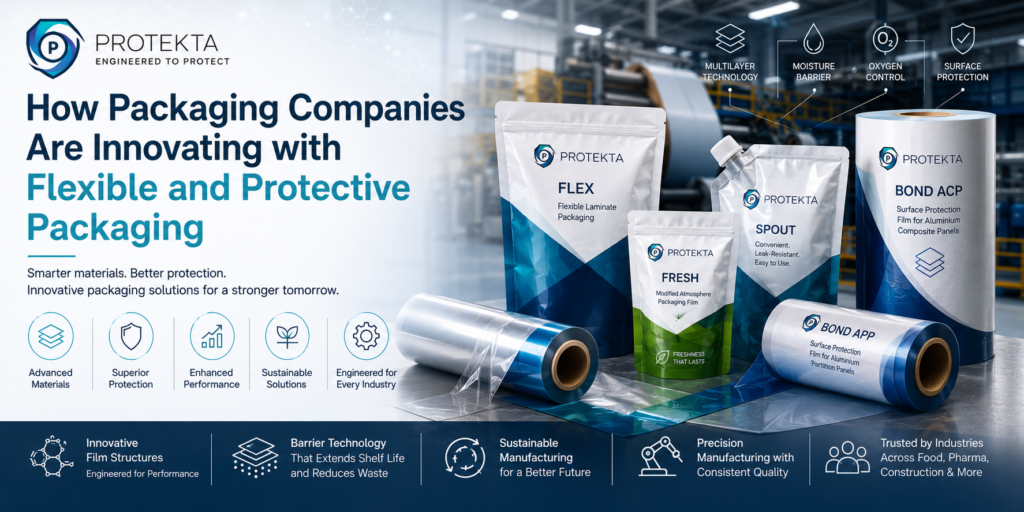
Protekta (protekta.in) is positioned as a full-service flexible packaging and surface protection film manufacturer, drawing on more than 40 years of manufacturing history from its parent company, Girdhar Roll Wrap. Its product range covers both ends of the packaging spectrum:
- PROTEKTA FLEX: Flexible laminate packaging designed for food and industrial applications
- PROTEKTA FRESH: Modified atmosphere packaging film for fresh food applications, aimed at extending shelf life
- PROTEKTA BOND ACP: Surface protection film specifically formulated for aluminium composite panels
- PROTEKTA BOND APP: Temporary surface protection film for aluminium partition panels
- PROTEKTA GUARD: General-purpose surface protection film for industrial surfaces
- PROTEKTA PLY: Multi-ply protective film solutions for demanding industrial environments
What distinguishes manufacturers like Protekta in a crowded market is not just product breadth, but the depth of manufacturing experience behind each film. When a surface protection film fails at 3 AM on a fabrication line, you want a manufacturer who has seen that failure mode before and knows what caused it.
Where Flexible Packaging Manufacturers Are Headed Next
A few trends are worth tracking if you source or specify packaging materials:
- Water-based adhesive systems: Replacing solvent-based adhesives in lamination processes to reduce VOC emissions and improve recyclability of the final structure
- Active packaging: Films that incorporate oxygen scavengers or moisture absorbers directly into the packaging structure, extending shelf life without separate desiccant sachets
- Thinner, stronger films: Advanced polymer blends are allowing manufacturers to reduce film gauge by 10 to 20% without reducing mechanical performance, cutting material costs and waste simultaneously
- Smart surface protection: Films with colour-change indicators that show when a surface has been exposed to excessive heat or impact during transit, allowing quality checks without removing the film
The Bottom Line
Packaging is no longer a commodity purchase. The materials going into flexible films and surface protection solutions are more technically sophisticated than they were ten years ago, and the performance gap between a well-specified packaging solution and a generic one is real and measurable, whether that means three extra days of shelf life for fresh produce or a scratch-free aluminium panel at the end of a complex installation project.
The packaging companies that are doing this well are the ones investing in materials engineering, quality systems, and the kind of application-specific knowledge that only comes from years of working closely with customers across multiple industries. That combination of technical depth and practical experience is what separates a reliable packaging partner from just another supplier.
Frequently Asked Questions
1. What is the difference between flexible packaging and rigid packaging?
Flexible packaging uses pliable film or foil structures that conform to the product shape, while rigid packaging uses fixed containers like glass jars or metal cans. Flexible formats are lighter, use less material, and often provide better barrier performance per gram of packaging weight. They are widely used in food, pharmaceutical, and industrial applications.
2. How does MAP packaging extend food shelf life?
Modified Atmosphere Packaging replaces the normal air inside a sealed pack with a controlled gas mixture, typically nitrogen, carbon dioxide, and sometimes oxygen, depending on the product. This slows down microbial growth and oxidation, keeping food fresher for longer. MAP is widely used for fresh produce, meat, seafood, and baked goods.
3. What should I look for in a surface protection film for aluminium composite panels?
Look for a film with adhesion strength matched to the panel coating, good resistance to tearing during CNC cutting or routing, and clean removability without adhesive residue. Film thickness typically ranges from 40 to 100 microns. Make sure the film is tested on your specific panel coating type before committing to a large order.
4. Are flexible packaging materials recyclable?
It depends on the film structure. Mono-material flexible films made from a single polymer type, such as all-polyethylene laminates, can be recycled through appropriate channels. Multi-material laminates using dissimilar polymers are harder to recycle and often end up in landfill. The industry is actively moving toward mono-material structures to address this, though performance trade-offs still exist in some applications.
5. How do I choose the right flexible packaging manufacturer for my application?
Start with application specifics: what product are you packaging, what are your shelf life requirements, and what filling or forming equipment are you running? A manufacturer worth working with will ask these questions before recommending a film. Also check for manufacturing consistency, lead time reliability, and whether they offer technical troubleshooting support for issues that arise on your line.