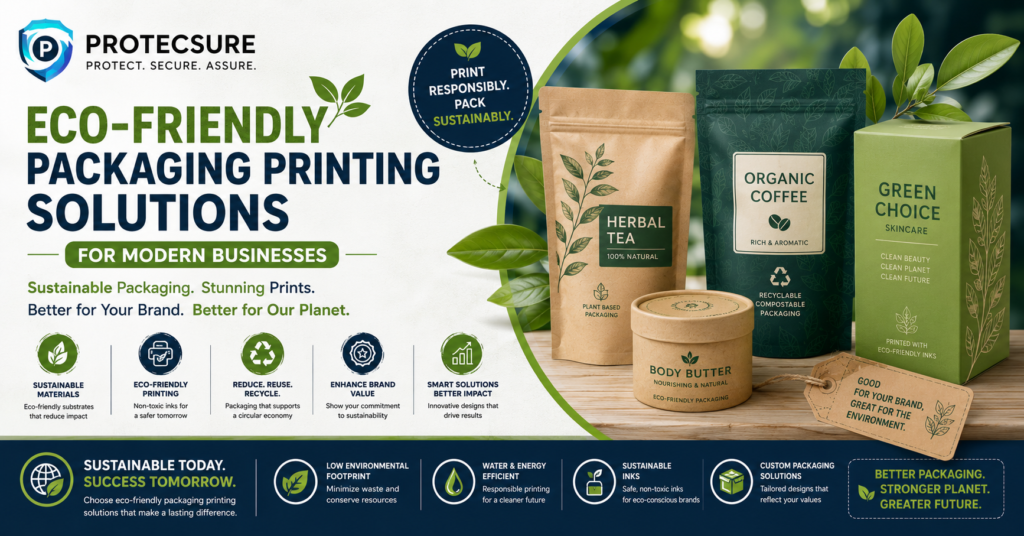
Walk down any grocery aisle today, and the shift is obvious. Matte-finish pouches printed with earthy tones, paper-based outer packaging carrying recycled content logos, and QR codes linking to sustainability reports. Brands across every category are redesigning their packaging, and the printing solutions that go on that packaging are changing just as fast as the materials underneath them.
For businesses trying to get eco-friendly packaging right, the challenge is not just choosing a greener substrate. It is understanding how the entire system—material, print process, ink chemistry, and end-of-life design—works together. Get one part wrong, and the sustainability gains in another part disappear.
Here is a clear-eyed look at what eco-friendly packaging printing actually entails and how modern businesses can make informed decisions that withstand regulatory scrutiny and consumer expectations.
Why the Push Toward Green Packaging Is Not Slowing Down
The numbers behind India’s green packaging shift are hard to ignore. The Indian green packaging market was valued at USD 9.0 billion in 2024 and is projected to reach USD 57.2 billion by 2033, growing at a CAGR of 22.5%. That trajectory makes green packaging one of the fastest-growing segments across the entire Indian economy.
Three forces are driving this simultaneously.
Regulation. India’s single-use plastic ban, Extended Producer Responsibility mandates, and 2025 plastic waste management amendments have made sustainability a legal requirement rather than a voluntary commitment. From July 2025, every piece of plastic packaging must carry a QR code or barcode for full supply chain traceability. Rigid packaging must incorporate at least 30% recycled content, and flexible packaging starts at 10% with phased increases through 2029. Packaging companies operating without documented recycled content programs now create direct compliance exposure for their brand customers.
Consumer pressure. A PwC survey of over 1,000 Indian consumers found that 84% were extremely or very concerned about food safety, and food safety concerns directly connect to packaging material choices. Globally, the pattern is clear: 59% of consumers actively look for sustainability information on labels, and 63% say they are less likely to buy products whose packaging they perceive as environmentally harmful.
Business economics. Flexible packs that replaced rigid glass and plastic containers cut freight costs by up to 70% per unit, according to Mordor Intelligence packaging data. Lighter packaging reduces emissions across the supply chain. Downgauged films that use less material per roll reduce input costs. The economics of sustainable packaging are no longer only about brand positioning; they are about direct cost reduction.
In July 2024, India’s Council of Scientific and Industrial Research launched a national mission specifically on sustainable packaging solutions, aiming for a net-zero future through integrated innovation across eight collaborating laboratories. This is institutional commitment to green packaging solutions at the national research level, not just corporate marketing.
What Makes Packaging Printing “Eco-Friendly”?
This is where the conversation gets more specific, because the term gets used loosely. Let’s break it down across four areas: substrate, ink chemistry, printing process, and end-of-life design.
The Substrate: What You Print On
Printing on a recyclable substrate does not automatically make a package recyclable. The ink and coating system applied on top must also be compatible with the recycling stream for that material.
For paper-based packaging, inks need to be de-inkable, meaning they can be removed during the paper recycling process without contaminating the recovered fiber. Soy-based and water-based inks on paper substrates meet this requirement far better than solvent-based alternatives.
For flexible plastic films, the recyclability picture is more complex. Traditional multilayer laminates bond dissimilar polymers, such as PET, aluminum, and polyethylene, in a way that makes separation for recycling extremely difficult. The industry is actively moving toward mono-material structures that use a single polymer type throughout the laminate. These can enter polyethylene or polypropylene recycling streams, depending on their composition.
For brands sourcing flexible packaging films, the substrate choice sets the ceiling on what your printing solution can achieve from a sustainability standpoint.
Ink Chemistry: Where Most Businesses Start Too Late
Conventional packaging printing has long relied on solvent-based inks, particularly in gravure printing processes used for high-volume flexible packaging. Solvent-based inks offer excellent adhesion on plastic films and fast drying speeds, but they come with a significant environmental cost: volatile organic compounds (VOCs) released during the printing and drying process.
VOC emissions from printing operations have direct health and environmental consequences. They contribute to air quality deterioration in manufacturing facilities and surrounding areas, and they complicate the recycling of printed packaging because solvent residues can contaminate recovered material.
Here is the spectrum of ink options and where they stand:
- Water-based inks use water as the primary carrier rather than solvents. They contain significantly lower VOC levels and are the most practical sustainable alternative for most packaging printing applications. Advances in polymer dispersion technology mean modern water-based inks now match or exceed the adhesion and print sharpness of alcohol-based solvent systems on flexible packaging substrates. For paper and paper-based packaging, water-based inks are also de-inkable, which supports recyclability.
- Soy-based inks are derived from soybean oil and are well-suited to paper packaging—corrugated boxes, shopping bags, and kraft paper wraps. They adhere well to paper fibers, reproduce color accurately, and break down more readily than petroleum-derived inks. Their limitation is substrate compatibility: soy-based inks do not adhere well to plastic films or metallized surfaces, which makes them appropriate for paper-based outer packaging but not for flexible film pouches.
- UV-curable inks cure instantly under ultraviolet light rather than through solvent evaporation. They contain no solvents and produce no VOC emissions during curing. However, some UV ink formulations contain photoinitiators that raise concerns around food contact migration, which requires careful compliance checking for food packaging applications.
- Electron beam (EB) curable inks cure using electron beams, which eliminates both solvents and photoinitiators entirely. Natural-based ink formulations using 50–90% renewable ingredients can reduce CO₂ emissions by 25–30% compared to conventional inks. These represent the leading edge of what packaging printing companies can offer, though the capital investment for EB printing equipment is substantial.
The global packaging inks market was valued at USD 10.19 billion in 2025, with flexographic printing holding a 51% share and growing. Flexographic printing is particularly well-positioned for the shift to water-based inks because it uses less ink volume than gravure, which means water-based formulations that dry more slowly can still be used efficiently at high press speeds.
The Printing Process: Flexo vs. Gravure vs. Digital
The choice of printing process affects the environmental footprint of packaging production beyond just ink chemistry.
Flexographic printing uses flexible relief plates and is the dominant method for printing on flexible packaging films, labels, and corrugated board. It is more compatible with water-based inks than gravure printing and generally uses less ink per unit area. For brands looking to shift toward eco-friendly packaging printing without a complete equipment overhaul, water-based flexo is typically the most practical path.
Gravure printing uses engraved cylinders and delivers extremely high print quality and consistency at large volumes. It has traditionally relied on solvent-based inks, and while water-based gravure inks exist and are being adopted by major beverage brands, the transition requires significant drying system investment. For brands with established gravure supply chains, the sustainability improvement path runs through solvent-less adhesive systems and washable ink formulations in the near term.
Digital printing changes the economics of sustainable packaging in a way neither flexo nor gravure can match: it eliminates printing plates entirely and makes short runs commercially viable. For brands running seasonal variants, regional language packaging, or limited-edition formats, digital printing removes the minimum order quantities that previously forced overproduction. Less overrun means less material waste. Digital packaging printing is forecast to reach USD 15 billion in India’s flexible packaging sector by 2035. Digital CMYK systems using water-based or low-VOC inks add sustainability credentials to the efficiency advantage.
How Regulatory Compliance Connects to Print Choices
The connection between printing decisions and regulatory compliance is tighter than many businesses realize.
Under India’s FSSAI packaging regulations, food contact materials must not transfer harmful substances into food. This applies to printing inks and adhesives used in food packaging laminate structures. Ink migration testing is a standard part of food-grade flexible packaging qualification, and the type of ink chemistry directly influences migration risk. Solvent-based inks have historically presented higher migration risk than water-based or UV-cured alternatives, particularly in laminate structures where the ink layer sits adjacent to the food contact film.
For brands exporting to the EU, compliance with EU Regulation 10/2011 on plastic materials intended to contact food sets specific migration limits and restricted substance lists. Ink systems must be evaluated against these lists, and packaging printing companies who work with export-oriented food brands need to supply documentation proving their ink formulations meet these standards.
India’s 2025 plastic waste amendments also require printed packaging to carry traceability information, such as QR codes or barcodes, allowing each package to be traced back to its producer. This is a printing requirement, not just a material requirement. It means every flexible packaging printing run for consumer products now needs to incorporate a functional QR code as a mandatory feature, not an optional brand tool.
What Sustainable Packaging Solutions Look Like in Practice
For a food brand selling snacks through modern retail and e-commerce: The packaging printing solution combines a BOPP or PET outer film with water-based flexographic printing, using a laminate structure that can incorporate recycled content in the sealant layer. The printed design carries a QR code linking to the brand’s EPR documentation and recycling guidance. The ink system meets FSSAI food contact standards and is documented with Safety Data Sheets for compliance audits.
For a pharma brand packaging tablets in blister packs with printed outer cartons: The outer carton uses water-based or soy-based inks on recycled paperboard, with certification confirming de-inkability for the paper recycling stream. The flexible blister film uses UV-cured inks with documented migration compliance for pharmaceutical packaging.
For an industrial manufacturer using surface protection films: Printed identification and specification information on surface protection films needs to be resistant to handling conditions while using ink formulations that do not leave residue on the protected surface during removal. This is a different set of constraints than food packaging but equally specific to the application.
Protekta’s Environmental Approach in Packaging Production
Protekta, manufactured by Girdhar Roll Wrap Ltd. from its Bhiwadi, Rajasthan facility, has built sustainability practices directly into its production infrastructure rather than treating them as a communication exercise.
The company operates an in-house plastic recycling plant that converts multilayer film waste generated during production into reusable granules for further processing. This closes the loop on production scrap rather than routing it to landfill. The facility follows safe manufacturing methods across all departments, from production and processing through to storage and transportation, and holds detailed Safety Data Sheets for every product in its range.
Protekta adheres to RoHS (Restriction of Hazardous Substances) and REACH (Registration, Evaluation, Authorisation and Restriction of Chemicals) standards, two of the most widely recognized international chemical safety frameworks. For brands sourcing packaging films from Protekta for food or consumer product applications, this documentation supports their own regulatory compliance position.
The company’s production infrastructure also includes multiple automatic pouching machines capable of producing zipper, stand-up, side gusset, and center seal pouches. Every printed film passes through an inspection machine as part of the quality control process. This end-to-end capability from raw film production through printing, lamination, and pouch conversion means brands working with Protekta can receive qualified, tested packaging rather than coordinating across multiple supply chain tiers.
What to Look for in Packaging Printing Companies
Not every packaging printing company is positioned to support a genuine shift toward eco-friendly packaging solutions. Here is how to tell the difference.
Ask for ink documentation. A credible partner should be able to confirm which ink system they use, its VOC content, its food contact compliance status if applicable, and whether it has been tested for de-inkability or migration. A supplier who cannot answer these questions specifically is not equipped to support a sustainability compliance program.
Check whether they can supply mono-material structures. If a packaging printing company works exclusively with traditional multilayer laminates using dissimilar polymers and has no mono-material option, your recyclability claims will face challenges. Ask specifically about PE-PE or PP-PP laminate options.
Verify recycled content capabilities. Brands required to meet India’s EPR recycled content targets need suppliers who can incorporate post-consumer recycled (PCR) material into film structures. Ask for the maximum percentage of PCR content available in each film grade and what performance trade-offs, if any, come with it.
Confirm traceability printing capability. From July 2025, every piece of plastic consumer packaging in India requires a machine-readable QR code or barcode. Confirm that your packaging printing supplier can consistently apply these codes with the resolution and contrast required for reliable scanning.
Review their own manufacturing environmental practices. A packaging company with an in-house waste recycling program, documented chemical safety standards, and transparent supply chain practices is a more credible sustainability partner than one that relies solely on marketing language.
FAQs
What is the most sustainable printing ink for flexible food packaging?
Water-based inks are the most practical choice for most flexible food packaging applications. They contain significantly lower VOC levels than solvent-based inks, meet food contact migration requirements when properly formulated, and are compatible with high-speed flexographic printing on BOPP and PET films. For paper-based outer packaging, soy-based inks offer similar sustainability benefits and superior de-inkability for the paper recycling stream.
Do sustainable packaging printing solutions cost more than conventional options?
The unit cost of water-based inks or digital printing can be comparable to conventional options at scale, though the equipment investment for switching from solvent-based gravure to water-based flexo is real. The more accurate comparison accounts for VOC compliance costs, ink waste reduction from digital short runs, and the regulatory cost of not meeting EPR documentation requirements. Many businesses find the total cost of sustainable printing solutions competitive once all factors are included.
What does a QR code on packaging actually need to contain under India’s 2025 regulations?
From July 2025, the QR code or barcode on plastic packaging must allow the item to be traced back to its manufacturer or brand owner. It must contain the unique identification number of the producer or a number issued under another applicable law. The code must be readable under standard scanning conditions, which sets minimum contrast and resolution requirements for the printing process used to apply it.
How does a brand verify that its packaging film supplier meets REACH and RoHS standards?
Ask the supplier for current Safety Data Sheets for every film product in use, a signed declaration of conformity against the REACH regulation’s substance of very high concern (SVHC) list, and RoHS compliance certificates for any film containing electronic or electrical components. For food contact applications, also request migration test data and FSSAI food contact material compliance documentation. These documents should be updated whenever the film formulation changes.
Can printed flexible packaging be recyclable?
It depends on two factors: the laminate structure and the ink system. Mono-material laminates, where all layers are made from the same polymer type, can enter appropriate plastic recycling streams. Multi-material laminates with dissimilar polymers generally cannot. The ink system must also be compatible; certain ink chemistries can contaminate recovered material during recycling. The combination of a mono-material substrate and a water-based or wash-off ink system gives the best chance of genuine recyclability.