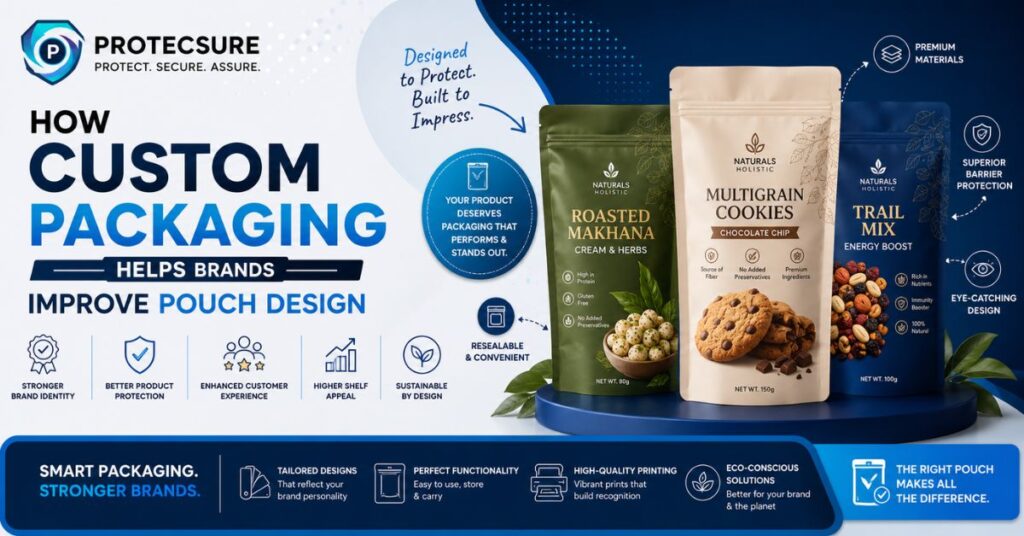
Pick up almost any product from a modern retail shelf, and there is a good chance it comes in a pouch. Snacks, sauces, protein powders, baby food, personal care gels, pharmaceutical powders, and flexible pouches have taken over category after category. And the brands winning in those categories are not winning with generic stock packaging. They are winning with pouches built specifically for their product.
Here is why custom packaging solutions have become the standard for serious brands and how the decisions made at the film and laminate level determine what your pouch can actually do.
The Scale of the Shift Toward Pouch Packaging
The numbers behind flexible pouch growth are not subtle. The Indian pouch packaging market was valued at USD 2.98 billion in 2024 and is on track to reach USD 4.49 billion by 2030, growing at a 7.03% compound annual growth rate. Flexible packs captured 54.32% of India’s total packaging market share in 2024, and brands switching from rigid containers to flexible pouches cut freight costs by up to 70%, according to Mordor Intelligence packaging data.
Stand-up pouches are the fastest-growing format within the category, expanding at a CAGR of over 6% through 2034 globally. Asia-Pacific holds a 40.12% share of the global pouch packaging market and is set to grow faster than any other region through 2030.
The shift is not just about cost. It is about what pouches can do that rigid packaging cannot: carry vivid branding across a larger printable surface; take up less shelf space; offer resealable closures; extend product shelf life through barrier engineering; and adapt to nearly any product form: liquid, powder, solid, or viscous.
Here is the catch. Not all pouches are the same. A pouch is only as good as the film it is made from, and the film only works if it is designed for the specific product inside. That is exactly where customized packaging solutions earn their place.
What “Custom” Actually Means in Pouch Packaging
When brands talk about custom pouch packaging, they usually mean one of two things: custom graphics or custom structure. Both matter, but they solve very different problems.
Custom graphics are what the consumer sees. Custom structure is what keeps the product safe.
A brand that invests in a beautifully printed pouch with the wrong laminate structure will still end up with oxidized flavors, moisture ingress, or heat seal failures. A brand with the right film structure but no investment in graphics will struggle to stand out at retail.
The best customized packaging material decisions address both simultaneously.
Let’s break it down by layer.
Outer Layer: Printability and Durability
The outer layer of a laminate pouch is typically a film like biaxially oriented polypropylene (BOPP) or polyethylene terephthalate (PET). These materials accept high-resolution flexographic and rotogravure printing well, which is why laminated pouches can carry photographic-quality graphics at commercial production speeds.
For brands, this layer is where the design story lives. The finished matte varnish, high-gloss coating, or metallized effect changes how the pouch reads on the shelf. Metallic finishes signal premium positioning. Matte finishes have become associated with natural and clean-label products. The outer film choice directly shapes consumer perception before anyone reads a word on the label.
Middle Layer: Barrier Performance
This is where structural decisions determine product shelf life. Barrier layers control how much oxygen, moisture, and light can pass through the film wall.
The most common barrier materials used in food-grade laminate structures are:
- EVOH (Ethylene Vinyl Alcohol): Excellent oxygen barrier, used in multi-layer structures for products sensitive to oxidation
- Aluminium foil: Near-complete protection against oxygen, moisture, light, and aroma loss; used in structures like PET/AL/CPP for maximum shelf life
- Metallized PET or BOPP: A cost-effective barrier option that blocks most moisture and light, suitable for dry snacks and biscuits where aluminum foil is unnecessary
The choice depends on what the product inside actually needs. Dry snack brands and biscuit manufacturers can typically use BOPP/CPP structures. Products with higher fat content, longer shelf life requirements, or sensitivity to light and oxygen require aluminum or EVOH-based constructions.
This is not a decision to make generically. A packaging film supplier who can specify the oxygen transmission rate (OTR) and water vapor transmission rate (WVTR) for each structure gives brands the technical data to make the right call for their product category and distribution chain.
Inner Layer: Seal Integrity and Food Safety
The inner layer contacts the product directly. It must be food-grade, chemically compatible with the product, and capable of forming a strong heat seal on automated filling lines. Cast polypropylene (CPP) and low-density polyethylene (LDPE) are common choices for the inner layer.
A poor inner layer choice creates seal failures, contamination risk, or incompatibility with the food product’s chemistry. Acidic products, oily products, and products with high moisture content each place different demands on the contact layer. Customized packaging solutions account for all three of these variables before specifying a laminate structure.
How Custom Pouch Design Gives Brands a Competitive Edge
Shelf Standout Through Print Quality
Pouches typically offer a larger printable surface than equivalent rigid packaging formats. That surface, printed well on the right film substrate, becomes a brand communication tool. India’s growing cosmetics and personal care segment has driven cosmetic manufacturers to invest in the visual appeal of flexible packaging pouches and tubes, specifically because of this printability advantage.
Ferrero Rocher Moments took this seriously in 2023 when the brand revamped its India packaging with pouches in factory-packed hang-sells and shelf-ready dispensers, maintaining gold-colored packaging and contemporary design patterns that reinforced the brand’s premium positioning while adapting to modern retail and e-commerce distribution.
Custom print is not a finishing touch. It is a structural decision made at the film specification stage because the outer film substrate determines what print process and what visual finish are achievable.
Functional Features That Build Consumer Loyalty
Customized packaging solutions allow brands to add functional features that generic stock pouches cannot provide:
- Resealable closures. Zipper systems held 28.75% of the global pouch packaging market share in 2024. For snack, pet food, and household categories, the ability to reseal a pouch after opening is a direct driver of repeat purchases. Consumers who cannot reseal a package switch to a competitor’s format next time.
- Spout and cap systems. These are the fastest-growing closure formats in the pouch market, projected to expand at a 5.86% CAGR through 2030. Liquid products, baby food, sauces, and on-the-go nutrition products increasingly use spouted pouches because they allow controlled dispensing without cutlery or separate containers.
- Stand-up base gussets. A flat-bottom or K-seal gusset allows the pouch to stand on the shelf independently. This matters enormously for retail placement, where brands compete for upright display rather than being stacked flat.
- Child-resistant closures. For pharmaceutical and nutraceutical products, child-resistant pouch formats are becoming a regulatory and liability requirement, not a choice.
None of these features can be retrofitted onto a generic stock pouch. They are designed at the film and conversion stage.
Lighter Weight, Lower Logistics Cost
Flexible pouches use approximately 70% less substrate than comparable rigid packaging formats. For large-volume food and personal care brands, that reduction translates directly into freight cost savings across millions of units. Brands that source customized packaging material sized precisely to their product volume—rather than using oversized stock formats—optimize material usage and reduce dimensional weight charges in shipping.
The move from rigid glass or plastic jars to flexible laminated pouches has driven measurable cost reductions for FMCG brands distributing into Tier 2 and Tier 3 markets, where longer transit times and less climate-controlled storage make both weight and barrier performance important.
The Film Is the Foundation: What to Demand From a Packaging Supplier
Brands often treat packaging film as a commodity purchase based on the price per kilogram. The cost of that approach shows up later in shelf life failures, heat seal inconsistency, consumer complaints, or compliance issues.
Here is what to look for when choosing a flexible film supplier for pouch packaging:
Barrier specification data. Any credible supplier of customized packaging material should be able to provide OTR and WVTR test data for every laminate structure they offer. If a supplier cannot specify these values, they cannot guarantee the shelf life your product needs.
Structure flexibility. Different products need different film structures. A supplier limited to one or two standard laminate configurations cannot adapt to a brand’s specific product requirements. Look for manufacturers who work across multiple film combinations (PET, BOPP, CPP, LDPE, EVOH, and aluminum foil) and who can propose structures based on your product’s actual requirements.
Consistency across production runs. Automated form-fill-seal packaging lines require films with consistent thickness, consistent heat seal initiation temperatures, and consistent reel geometry. A film that varies across batches causes downtime on filling lines, wasted product, and packaging failures.
Food safety compliance. For food applications, the film manufacturer should hold safety data sheets for all products and comply with applicable standards. In India, FSSAI packaging regulations govern food contact materials. For export, FDA 21 CFR or EU Regulation 10/2011 compliance may be required, depending on the target market.
Sustainability documentation. Under India’s Extended Producer Responsibility framework, brands need recycled content documentation and compliance records from their packaging suppliers. A supplier who cannot provide this creates compliance exposure for the brand.
Protekta’s Role in Flexible Packaging for Pouches
Protekta, manufactured by Girdhar Roll Wrap Ltd. with over 40 years of manufacturing history behind it, supplies flexible laminate packaging films from its facility in Bhiwadi, Rajasthan. Their PROTEKTA FLEX range covers flexible laminate packaging for food and industrial use, and their PROTEKTA FRESH range is built specifically for fresh food applications requiring modified atmosphere performance.
The company produces 200 metric tons of flexible laminates monthly and maintains over 100 quality checkpoints across its laminate production line. Protekta holds safety data sheets for all products and adheres to RoHS and REACH chemical safety standards, which support the compliance documentation brands need for food-grade packaging sourcing.
For brands sourcing flexible laminate films for pouch packaging applications, Protekta offers both the technical depth and the production consistency that high-speed filling lines require.
Where the Pouch Packaging Market Is Heading
Two trends are reshaping what customized packaging solutions look like in the near term.
Mono-material structures for recyclability. Traditional laminate pouches bond dissimilar materials, such as PET, aluminum, and polyethylene, that are difficult to separate for recycling. The industry is moving toward mono-material pouch structures, primarily PE-PE or PP-PP laminates, that maintain barrier performance while supporting mechanical recycling. This transition is driven by India’s plastic waste management amendments, which require recycled content targets and EPR compliance. Flexible packaging starts at 10% recycled content requirements in 2025 with phased increases through 2029.
Digital printing for short-run customization. Digital printing technology has made it commercially viable for brands to run short-run custom print jobs, seasonal variants, regional languages, and promotional packaging without the plate costs and minimum order quantities that rotogravure printing traditionally required. Flexography and digital printing are projected to reach USD 20 billion and USD 15 billion, respectively, in India’s flexible packaging market by 2035. Brands that previously could only afford one packaging design per SKU can now run multiple market-specific variants efficiently.
Both trends require planning at the film specification stage, not at the graphics design stage. The structure determines what is recyclable. The outer film choice determines which print process is viable.
FAQs
What is the difference between custom pouch packaging and stock pouch packaging?
Stock pouches are pre-made in standard sizes and dimensions with no product-specific engineering. Custom pouch packaging starts with specifying the laminate film structure based on the product’s barrier requirements, then the format and size, and finally the print design. Custom packaging is matched to the product; stock packaging requires the product to fit the packaging.
How do I know which laminate structure my product actually needs?
The answer comes from two inputs: the product’s sensitivity to oxygen, moisture, and light, and the intended shelf life under your distribution conditions. A packaging film supplier who can provide OTR and WVTR data for different laminate structures can help match the film specification to your product’s actual requirements. Do not rely on category norms alone; products vary significantly in their packaging demands.
What pouch formats work best for food brands selling through e-commerce?
Stand-up pouches with zipper closures perform well in e-commerce because they survive transit without compromising product integrity, allow consumers to reseal after opening, and carry strong branding on a large print surface. Spouted pouches work for liquid products. The outer laminate should have sufficient puncture resistance for courier handling, which typically means a PET-based outer layer rather than a BOPP-only structure.
Are flexible pouches sustainable compared to rigid plastic packaging?
Flexible pouches use significantly less material than rigid packaging formats, which reduces the total plastic volume per unit sold and cuts transport emissions through lighter load weights. The challenge is end-of-life recyclability, particularly for multi-material laminates. Mono-material pouch structures in PE or PP are increasingly available and support mechanical recycling, though they may require barrier performance trade-offs depending on the product category.
What should a brand verify before approving a flexible film supplier for pouch production?
Verify that the supplier can provide barrier specification data (OTR and WVTR values) for each laminate structure, food safety compliance documents for food-contact applications, Safety Data Sheets for all materials, and EPR compliance records under India’s plastic waste management regulations. Also assess their production consistency by requesting data on thickness tolerance and seal strength across production runs.