
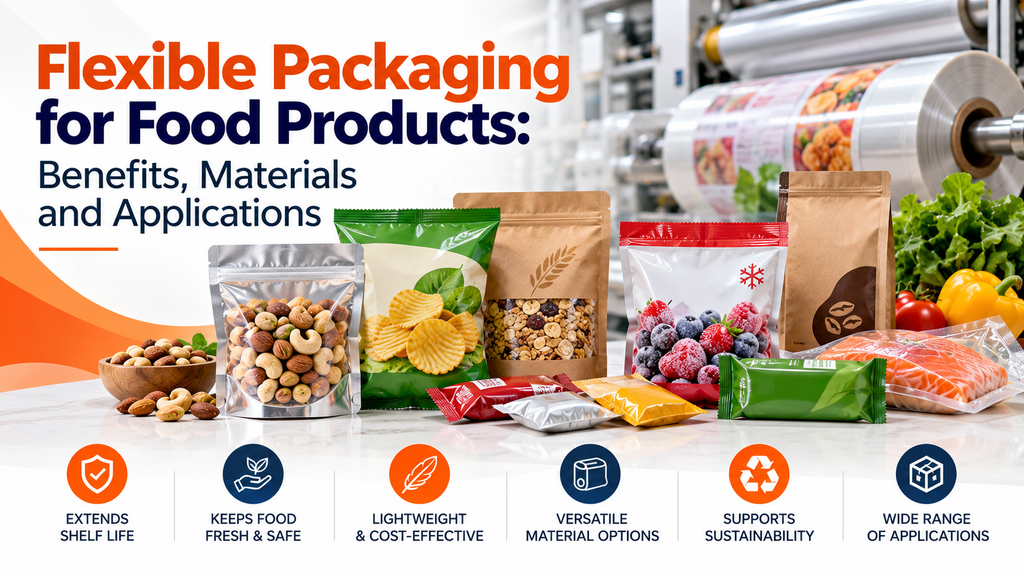
Walk through any grocery aisle and count the pouches. Chips, biscuits, tea, flour, salt, and ready meals all sit in flexible packs. That shift did not happen by accident. Flexible food packaging protects food, weighs little, and gives brands a large surface for print. Still, a pouch that works for tea can fail for chips, and the reason is almost always the material.
Let’s break it down. This guide covers the benefits of flexible packs, the materials behind them, and the foods each one suits. You will also find a simple selection method, a look at Indian food-contact rules, and answers to common questions.
Why Food Brands Choose Flexible Packs
Here are the main benefits:
- Longer shelf life: Barrier layers slow down moisture, oxygen, and light damage.
- Contamination protection: A sealed laminate keeps dust, moisture, and outside odors away from the food.
- Low weight: Light packs cost less to ship than glass, tins, or rigid tubs.
- Print appeal: Smooth film takes sharp graphics, so the pack sells the product on the shelf.
- Flexible formats: Makers can supply film on reels for filling machines or as ready-made pouches.
- Less food waste: Food that lasts longer is less likely to end up in the bin.
The last point deserves a closer look. The Flexible Packaging Association reports that its studies conclude flexible packaging reduces food waste when companies look at the product and the package together as one system. That wording matters. A good pack cannot rescue a poorly handled product, but a well-matched pack gives good food more time.
Time matters most for fresh produce. A FreshPlaza report on postharvest packaging cites FAO data and says the global loss rate for fruits and vegetables between production and retail reached 25.4 percent in 2023. The same report adds that packaging can slow respiration, cut moisture and weight loss, and help produce keep its firmness and appearance longer.
Weight is the other everyday benefit. The Flexible Packaging Materials: Types, Uses and How to Choose the Right One guide from Protekta explains the different material options, applications, and factors to consider when selecting flexible packaging. Flexible materials can also cut shipping costs while still protecting the product. Lighter loads also mean fewer trips for the same volume of food.
What Flexible Packaging Is Made Of
The Flexible Packaging Association describes the category plainly. Makers can build a flexible pack from paper, plastic film, foil, or any combination of them, and it often takes the form of a bag, pouch, wrap, lidding, or rollstock. Food packs rarely use just one of these. Most combine layers so each layer does one job.
Materials Used in Flexible Food Packaging
Short answer first. These are the materials you will meet most often:
- PET (polyester) film
- BOPP (biaxially oriented polypropylene) film
- CPP (cast polypropylene) film
- Aluminum foil
- Metallized PET and BOPP films
- Paper, usually paired with film or foil
Now let’s see what each one does for food.
PET Film
PET gives a pack its backbone. It usually offers an excellent oxygen barrier, a moderate moisture barrier, and better stiffness and tensile strength than BOPP. Oils in snacks and nuts react with oxygen, so that oxygen barrier counts. PET also runs well on filling machines and holds print cleanly.
BOPP Film
BOPP is the workhorse of dry food packs. It improves on the moisture barrier of PET and usually costs less unless you add coatings or metallization. Dry foods like biscuits and wafers turn soft when moisture creeps in, so a moisture barrier protects texture. BOPP comes in clear, opaque, pearlized, and heat-sealable versions, which gives designers real choices.
CPP Film
CPP sits on the inside of most pouches. It is a soft film that resists tears and punctures and delivers high seal strength and burst strength. Think of a heavy bag of salt or flour. The seal has to hold when the bag drops or gets stacked. That is CPP’s job.
Aluminum Foil
Foil gives a very strong barrier against light, moisture, and gases. Packers use it when a food loses quality fast, such as ground coffee or spice blends. The trade-off is cost and an opaque pack, so you cannot see the food inside.
Metallized Films
A thin metal coating on PET or BOPP adds barrier at low weight and cost. Cosmo Films, a major Indian film maker, says its metallised BOPP suits biscuits, snacks, bakery items, chocolates, and shampoo sachets, where moisture barrier matters most. That list reads like a snack shelf, which shows how common metallized films are in food.
Paper
Paper offers a natural look and takes print well. Plain paper lets moisture and oxygen through, so converters laminate it with film or foil for most food uses.
How a Food Packaging Film Is Built
A laminate works like a sandwich. Each layer has a role:
- Outer layer: carries print and adds stiffness. PET or BOPP often fills this role.
- Middle layer: blocks oxygen, moisture, and light. Foil or metallized film often fills it.
- Inner layer: seals the pack and touches the food. CPP or a heat-sealable film often fills it.
Barriers against oxygen, moisture, light, and contaminants decide how long a product keeps its quality. One film rarely blocks all four and also seals well. So makers stack films until the structure fits the food.
Simple foods may need only two layers. Fast-spoiling or aroma-rich foods usually need three. Each added layer costs money and adds weight, so match the structure to the product instead of over-building it.
Applications: Matching Packaging to the Food
Different foods break down in different ways. Use this list as a starting point:
- Chips and snacks: Oxygen turns fats rancid, and moisture kills crunch. Metallized laminates are a common match.
- Biscuits and cookies: They go soft fast, so moisture barrier comes first. Seals also need to survive transport without cracking.
- Chocolate and candy: They need moisture control and a glossy print finish. Heat-sealable BOPP laminates fit many formats.
- Tea and coffee: Aroma escapes easily and outside odors sneak in. High-barrier structures with foil or metallized layers protect both.
- Salt and wheat flour: Humidity causes clumping, and heavy loads stress the seals. Moisture resistance and puncture strength lead the checklist.
- Fresh fruit, vegetables, and ready-to-eat foods: These items still respire or spoil quickly, so films need to manage moisture and freshness.
Your own recipe will change the answer. Fat content, particle size, and storage temperature all shift what a pack needs.
How to Choose Packaging for Your Food Product
Follow these steps to choose a food packaging film that fits your product.
- Name the main threat. Decide whether moisture, oxygen, light, or aroma loss hurts your food most.
- Set a shelf life target. A snack that sells in three weeks needs less barrier than one that sits for six months.
- Check your sealing method. Heat sealing and cold sealing need different films, and your machine decides.
- Test strength. Look at sharp edges, drops, and stacking in warehouses.
- Choose the look. Clear film shows the food. Opaque or metallized finishes shift attention to the brand.
- Confirm food-contact rules. Check the layer that touches the food before you approve anything.
- Run a trial. Fill, seal, store, and ship a small batch before you commit to a large order.
- Compare cost against waste. A cheap pack that spoils food costs more than a better pack that does not.
Food Safety and Compliance in India
In India, food packaging falls under the Food Safety and Standards (Packaging) Regulations, 2018. Any material that touches food must be food grade, must suit the product, storage conditions, and filling equipment, and must withstand the mechanical, chemical, and thermal stresses of normal transport.
Laminates face a specific test. In a multilayer pack, the layer that touches food, and any layer likely to touch it, must meet the schedule requirements for its material. The rules also state that a printed surface must not come into direct contact with food. That is why converters keep ink away from the food side of the film.
Rules can change, so check the FSSAI website for the latest notices before you approve a final spec. Ask your aluminium protective film supplier for documents that show the food-contact layer meets the relevant standard.
Food-Related Products on the Protekta Website
A real product range shows how these ideas turn into catalog items. Protekta Flex, made by Girdhar Roll Wrap Ltd., supplies flexible laminate packaging rolls and pouches. According to the product page, the multilayer sheets combine materials such as PET, paper, and aluminum, and the range draws on PET, Met PET, BOPP, Met BOPP, CPP, and barrier films.
The laminate types listed include two layer and three layer laminates, BOPP two layers, BOPP metalized two layer, BOPP heat-sealable, BOPP opaque, pearlized finishes, and milky two layers. The page names food uses such as biscuits and cookies, chocolate, candy, salt, wheat flour, tea and coffee, and chips and snacks. It also lists eco-friendly options and says buyers can order in reel form or as pre-formed pouches.
The same site lists a separate line for produce. Protekta Fresh covers fresh packaging films designed to preserve freshness, hygiene, and shelf life for fruits, vegetables, and ready-to-eat food products. Notice how the two lines split the work. One handles dry and packaged foods, and the other handles items that spoil quickly.
Next Steps
Start with a one-page spec. Write down your food, its biggest threat, your shelf life target, your sealing method, and the look you want. Share it with a few film suppliers and ask for samples. Then run fill-and-store trials before you place a bulk order.
To see how a laminate range is organized, review the product page.
FAQs
What materials are used in food pouches?
Food pouches usually combine PET, BOPP, CPP, aluminum foil, or metallized film. Each layer handles a task such as printing, barrier protection, strength, or sealing. Makers pick the mix based on how fast the food spoils.
How does flexible packaging extend shelf life?
Barrier layers slow the movement of moisture, oxygen, and light into the pack. Sealed edges keep out contaminants. Slower damage means the food stays fresh, crisp, or aromatic longer. The right structure depends on what spoils your specific food.
Is flexible packaging safe for food?
It can be, when the layer touching food meets Indian food-contact rules. FSSAI requires food-grade material, and printed surfaces must stay off the food side. Ask suppliers for documents that confirm compliance before you approve a pack.
Which food packaging film suits chips and biscuits?
Chips and biscuits need strong moisture and oxygen protection plus reliable seals. Metallized BOPP or MetPET laminates are common choices. Your recipe, shelf life target, and filling machine decide the final structure, so always test samples first.
Can flexible packs help reduce food waste?
Yes, when they match the food. The Flexible Packaging Association says its studies link flexible packaging to lower food waste when product and package are planned together. Longer shelf life gives food more time to reach shoppers.
Pingback: What Is Modified Atmosphere Packaging and How Does It Extend Shelf Life?